Credible elections are fundamental to democratic legitimacy. Across Sub-Saharan Africa, the adoption of digital electoral tools has grown steadily, reflecting a broader continental effort to modernise election administration, curb malpractice, and rebuild public trust in democratic processes. Nigeria, Kenya, and Ghana represent particularly instructive trajectories, having each invested substantially in biometric technology to address persistent challenges of fraud, administrative inefficiency, and institutional weakness. Nigeria’s response has been the most technologically ambitious. But has this technology reduced electoral fraud in these countries, and what lessons does it hold for the rest of Africa?
Nigeria: Verified Voters, Contested Results
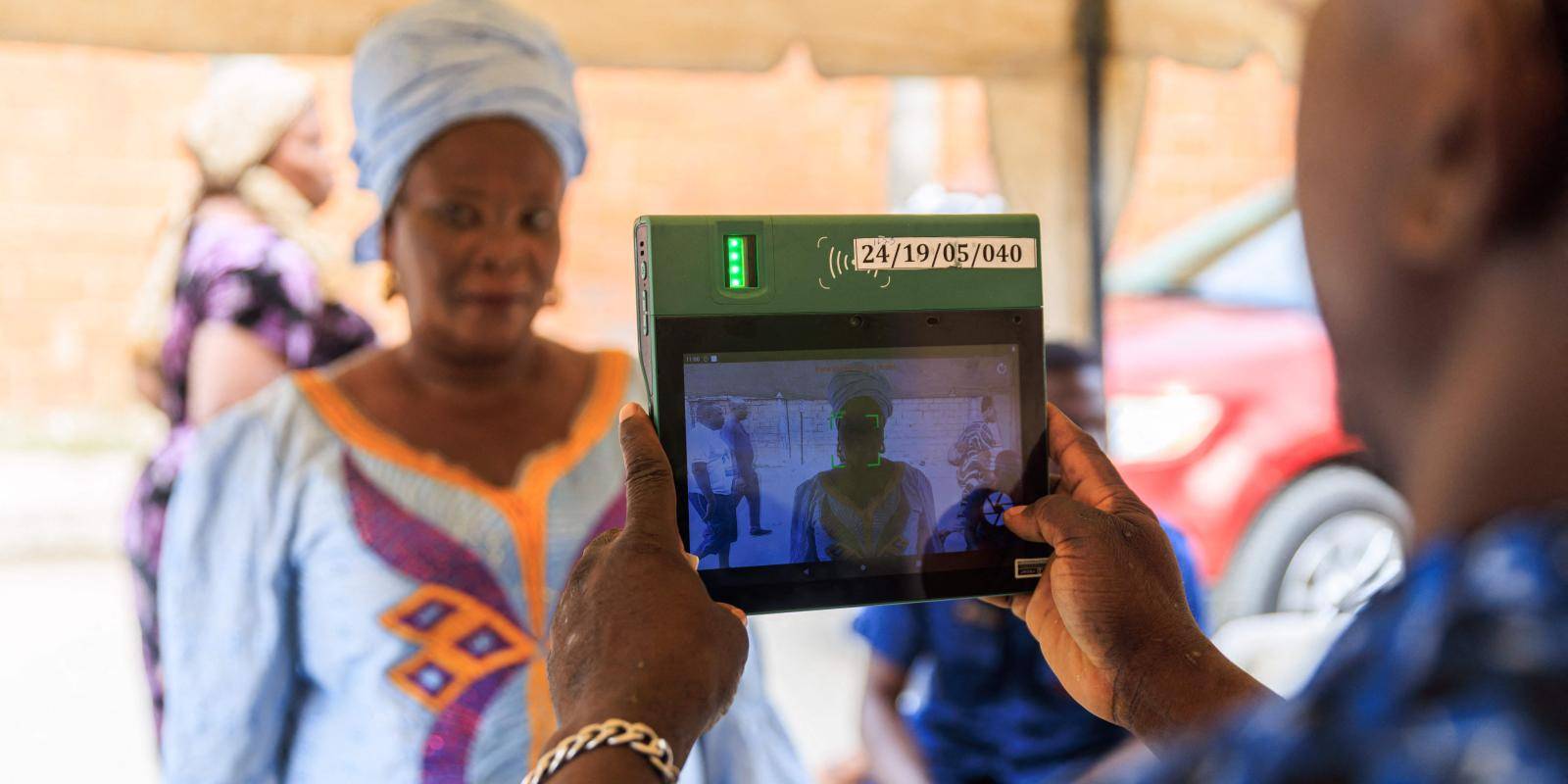
Nigeria’s digital transition unfolded through successive phases, each building on the last. Biometric Voter Registration from 2011 created a centralised digital database that significantly reduced duplicate registrations and improved the accuracy of the voter roll. In its first major clean-up exercise, INEC removed 16.5 million duplicate entries from the register, a scale of correction unmatched by manual verification. The Permanent Voter Card embedded biometric data directly in the voter’s document, preventing forgery and linking identity to the register. Smart Card Readers, introduced at the 2015 general election, made voter impersonation substantially harder by requiring fingerprint authentication at the point of accreditation an innovation widely credited with making that election among Nigeria’s most credible. The Bimodal Voter Accreditation System (BVAS), deployed in the 2020–2023 electoral cycle, represented the most significant upgrade: The BVAS combined fingerprint scanning and facial recognition to authenticate voters by cross-referencing their biometric data against the INEC’s database. After voting, ballots were counted and endorsed by an INEC officer before the BVAS captured and transmitted result sheets to the portal. The process was nonetheless marred by controversy. Instances where votes recorded exceeded BVAS accreditation figures emerged as a central irregularity in the 2023 Nigerian presidential election, with petitioners alleging over-voting across multiple states using evidence drawn directly from the IReV portal. Across all phases, the pattern is consistent: front-end improvements in voter identity verification have been measurable and significant. What has proved harder to secure is the back end: the transmission, collation, and declaration of results.
Kenya: Sophistication Without Settlement
Kenya’s investment in electoral technology has been heavier still, yet its disputes follow a familiar script. In its drive to modernise electoral administration, the Independent Electoral and Boundaries Commission (IEBC) has invested substantially in the technological architecture of elections, with each cycle bringing a more sophisticated suite of tools. These include the Biometric Voter Registration (BVR), Kenya Integrated Electoral Management System (KIEMS), Candidate Registration Management System (CRMS), Results Transmission System (RTS) deployed progressively across multiple election cycles. The measurable gains are real: biometric registration has reduced duplicate entries, election-day processing has become faster, and collation timelines have shortened. Yet Kenya’s experience also illustrates a fundamental limitation. Post-election contestation has not diminished; it has simply relocated. Legal challenges following the 2017 and 2022 elections focused significantly on whether electronic transmission systems were tampered with or failed, rather than on the integrity of the voter register itself. This pattern is borne out beyond the courtroom: one analysis of the 2022 elections observed, disputes centred overwhelmingly on transmission reliability rather than registration integrity. The Supreme Court’s annulment of the 2017 presidential election result citing irregularities in the transmission process underlines the point with rare clarity: even in a technologically advanced system, the transmission layer remains the critical and most contested node.
Ghana: Consensus as Infrastructure
Ghana presents a deliberate contrast. The Electoral Commission of Ghana, headed by Dr. Kwadwo Afari-Gyan, introduced biometric voter registration and biometric verification for the 2012 elections, with the ‘No Verification, No Voting’ (NVNV) policy given legal backing ahead of its deployment, albeit amid disagreement between political parties. Voter verification failures did occur, and challenges such as the slowing of the voting process, inadequate understanding of the biometric system, and device breakdowns were real, compounded by the absence of reliable real-time connectivity between registration centres and an electronic national register. Despite these early setbacks, biometric verification measurably strengthened voter authentication in subsequent cycles. Yet over the years, what distinguished Ghana was not the sophistication of its tools, but the institutional logic guiding their introduction. The Electoral Commission built stakeholder consensus before advancing reforms, operating through IPAC to consult political parties on electoral law changes prior to their enactment. This sequencing mattered enormously. The result was a system in which, even when electoral disputes arose and directly implicated the Commission’s conduct, the ECG’s institutional legitimacy survived, a resilience rooted less in the technology deployed than in the consultative foundation upon which reforms had been built. This reflects an approach that treats institutional legitimacy as the precondition for technological effectiveness, rather than its consequence.
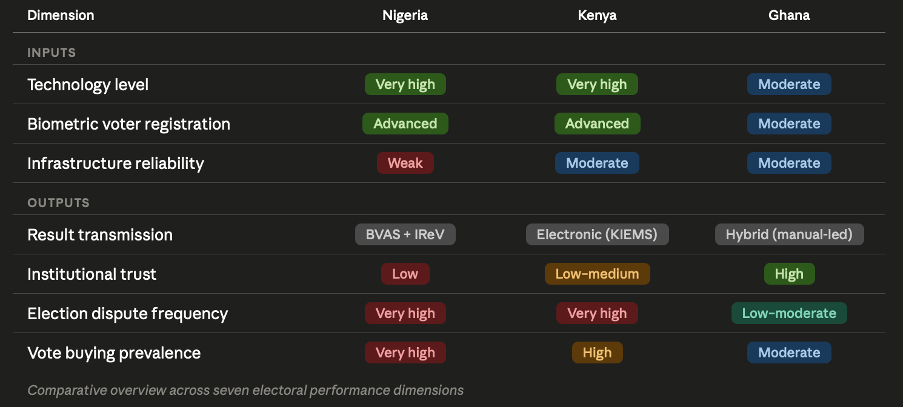
The evidence from all three countries points to a consistent pattern: digital tools have reduced first-order electoral fraud (impersonation, duplication, and physical manipulation) while simultaneously creating or exposing new vulnerabilities. Biometric registration has made multiple registration materially harder, and digital accreditation logs create audit trails that limit scope for inflating results at the polling-unit level. These are genuine gains. In Nigeria, card readers deterred industrial-scale impersonation that marred earlier cycles. In Kenya, biometric registration significantly reduced a voter roll long plagued by ghost voters. In Ghana, verification devices added an authentication layer to a process whose credibility previously rested on institutional reputation alone.
Yet what biometric tools were never designed to address is the political economy of elections. Vote buying persists across all three countries because it operates entirely outside polling-unit technology. Cash payments and material inducements precede the voting act. Technology addresses who votes; it cannot address what voters were promised before they arrived. Contestation has accordingly shifted from registration to results management. Nigeria’s 2023 elections illustrated this most sharply: despite accurate biometric accreditation, disputes arose over delayed uploads and discrepancies between polling-unit totals and announced figures, a transparency paradox where more data generated less perceived legitimacy. Kenya shows the same pattern: its Supreme Court annulled the 2017 presidential result over transmission failures, not registration fraud, and 2022 brought renewed contestation over transmission integrity, though the Supreme Court ultimately upheld the result. The trend is clear: as front-end fraud becomes harder, the back end becomes the target.
A further dimension of the fraud transformation is institutional. Nigeria and Kenya demonstrate that electoral technology is only as effective as the institutions governing it. Technical tools deployed in elections depend on trained officials, procedural discipline, and institutional independence to translate accurate data into accepted outcomes. Where these conditions are absent or perceived to be absent, technology generates data without generating trust. This is the central lesson of the comparative experience examined: the credibility problem in elections is not principally a technical problem, and it cannot be principally resolved by technical means. Where citizens distrust institutions and information outpaces verification, perceived legitimacy suffers even without any technical breach. Ghana’s resilience owes more to the Electoral Commission’s institutional credibility than to the sophistication of its tools. Weak institutional trust means even accurate outputs are contested; strong trust allows modest systems to deliver credible results.
Taken together, Nigeria, Kenya, and Ghana tell a single story with three variations: technology has not eliminated electoral fraud; it has transformed it. The most urgent priority remains the results transmission layer. Mandatory audits, real-time public dashboards, and clear protocols for technical failures could make discrepancies immediately visible. Infrastructure resilience, cybersecurity, and campaign finance enforcement must follow closely. The deeper lesson, however, is that Ghana’s experience shows that institutional credibility can compensate for technological modesty, but the reverse does not hold. Advanced technology deployed within distrusted institutions produces sophisticated disputes, not stable outcomes. Sustainable electoral credibility requires the alignment of three things no single reform delivers alone: capable technology, resilient infrastructure, and institutions trusted enough to make their outputs stick.