

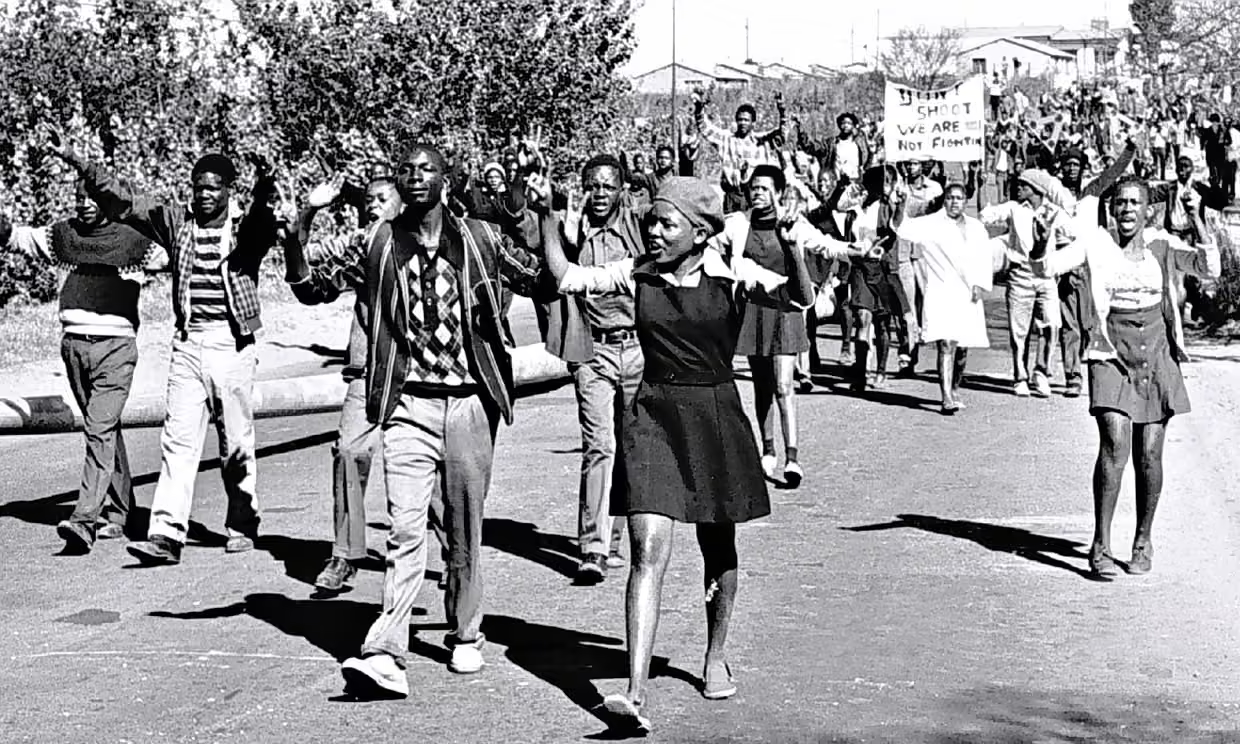
When, in June 1976, thousands of South African secondary school students marched against the imposition of Afrikaans as a language of instruction in schools, they were unaware that the battle was transgenerational and transterritorial. The battle they had taken on was against a global force that had determined that the language and culture of the militarily and economically stronger were superior to others.
The Battle Beyond Soweto
The images of the Soweto Massacre remain etched in global memory; schoolchildren marching through the streets of Soweto, demanding dignity and educational justice; heavily armed police responding with bullets that felled hundreds of students; and the lifeless body of 13-year-old Hector Pieterson carried through the chaos. While the tragedy of Soweto is visible and can be commemorated, the invisible, unsung reality is that over the past several decades, hundreds of millions of lives have been lost or, at best, consigned to mediocrity as a result of the destruction of indigenous languages around the world.
In Decolonising the Mind, Ngugi Wa Thiongo contended that the domination of African peoples was sustained through the domination of their languages. “Language carries culture, and culture carries, particularly through orature and literature, the entire body of values by which we come to perceive ourselves and our place in the world.” The resistance of Soweto students reveals Ngugi’s submission that language is never neutral; it carries history, culture, values, and ways of understanding the world. For the students, the issue was about identity, power, and the right to think, learn, and dream in languages that reflected their realities.
Years before the Soweto Uprising, Cheikh Anta Diop argued in The Cultural Unity of Black Africa that African cultural and political renewal requires linguistic renewal and the development of African languages as vehicles of modern knowledge. In Black Africa: The Economic and Cultural Basis for a Federated State, Diop explicitly discusses language policy, education, and the necessity of developing African languages for administration, science, and national development.
Cheikh Anta Diop called for African languages to become vehicles of scientific and intellectual development. Rejecting the notion that African languages were inherently inferior or incapable of expressing complex ideas, Diop argued that they possessed the same capacity for intellectual rigor as any other language. He maintained that the continued dependence on European languages in African education created a disconnect between formal learning and the lived realities of African societies.
Diop demonstrated this conviction through his own scholarly work, including efforts to show that African languages could accommodate modern scientific terminology.When education is conducted exclusively in foreign languages, he argued, students are often compelled to think within conceptual frameworks that are detached from their cultural contexts. By contrast, the use of indigenous languages in schools and universities would allow African societies to draw upon their own intellectual traditions while engaging confidently with global knowledge.
Viewed through these lens, the Soweto students’ resistance to linguistic domination acquires an even deeper meaning. Their protest against the imposition of Afrikaans becomes a battle against a power structure that sought to entrench a system that dictated the terms through which knowledge could be acquired and expressed.
Africa, the World, and Indigenous Languages
Half a century later, the questions raised by the Soweto Uprising remain relevant. Across Africa and many other parts of the world, indigenous languages continue to occupy a precarious position. While governments often celebrate linguistic diversity rhetorically, educational systems frequently privilege former colonial languages as the primary mediums of instruction. Parents, seeking economic opportunities for their children, may encourage exclusive use of English, French, Portuguese, or other global languages, sometimes at the expense of mother tongues.
The consequences are increasingly visible. UNESCO estimates that many of the world’s languages are endangered, with some disappearing every few weeks. As elder speakers pass away, valuable cultural and intellectual heritage risks vanishing with them. In Africa, where linguistic diversity is among the richest in the world, this challenge is particularly acute.
When a language is silenced, more than words are lost. Entire ways of seeing the world become endangered. Indigenous languages contain generations of accumulated wisdom about ecology, medicine, spirituality, conflict resolution, and community life. They preserve cultural memory and provide the conceptual frameworks through which people interpret reality. The erosion of these languages therefore represents a loss not only for their speakers but also for humanity as a whole.
The students who marched in Soweto understood this connection intuitively. They recognized that language could either empower or alienate. Being forced to learn through Afrikaans symbolized a broader system that sought to control their minds and diminish their humanity. Their protest was, in many respects, a demand for epistemic freedom—the freedom to learn and know through cultural frameworks that resonated with their lived experiences.
The Legacy of Soweto
The death of two hundred students in what has been called the Soweto Massacre was not in vain. The legacy of Soweto offers courage and hope. Today’s generation are rising to honor that legacy by advocating for multilingual education, supporting indigenous language publishing, creating digital content in local languages, and recognizing linguistic diversity as a resource rather than an obstacle to development. Today, Indigenous languages are making their way into popular language apps such as Duolingo and Mango App among others.
Importantly, there is a growing realization that promoting indigenous languages does not equate to rejecting the more globalized languages. It is not a choice between English and isiZulu, French and Wolof, or Portuguese and Kimbundu. The emphasis is on creating educational and social systems in which indigenous languages coexist with more globalized languages on terms of dignity and mutual respect. Multilingualism has been scientifically established to be an asset that expands rather than limits intellectual horizons.
Fifty years after the Soweto Massacre, we remember the students who took to the streets for their courage in defending their right to define themselves, tell their own stories, and preserve their cultural inheritance. Their sacrifice reminds us that language is inseparable from freedom.

