In recent years, Sub-Saharan Africa has witnessed a resurgence of military coups, particularly across the Sahel and parts of West and Central Africa. Countries such as Mali, Burkina Faso, Niger, Gabon, Chad, Guinea, Sudan, and Guinea-Bissau have all experienced military intervention in politics. At face value, these coups appear to represent a clear rejection of liberal-democratic governance. Rather than signalling an outright rejection of democracy, these events reflect a deeper and more troubling phenomenon: a crisis of legitimacy in governance. Coups in the Sahel and across Sub-Saharan Africa reflect widespread dissatisfaction with governments that have failed to provide security, accountability, and effective governance. An examination of coup patterns, public responses, and regional reactions suggests that the central challenge is the erosion of state legitimacy resulting from the perceived failures of liberal democratic governance, a crisis that lies at the heart of the current instability. Addressing this instability therefore requires a shift beyond procedural democratic frameworks toward substantive reforms that improve governance and state performance.
The post-Cold War period saw a wave of liberalisation across Africa, marked by the adoption of multiparty elections, constitutions, and formal democratic institutions. Many of the countries now experiencing coups had, at least on paper, democratic systems in place prior to military intervention. However, the presence of elections did not necessarily translate into effective governance. In Mali, Burkina Faso, and Niger, repeated electoral cycles and the maintenance of formal democratic structures failed to stem the spread of jihadist insurgencies, restore public confidence in the state, or prevent escalating insecurity. Governments struggled to provide basic public goods, including safety, economic stability, and administrative capacity. In Gabon, decades of rule by the Bongo family led to widespread perceptions of electoral manipulation and dynastic governance. In Guinea, constitutional changes enabling extended presidential rule eroded trust in democratic norms. In Chad, military succession following the death of President Idriss Déby blurred the line between constitutional order and military control.
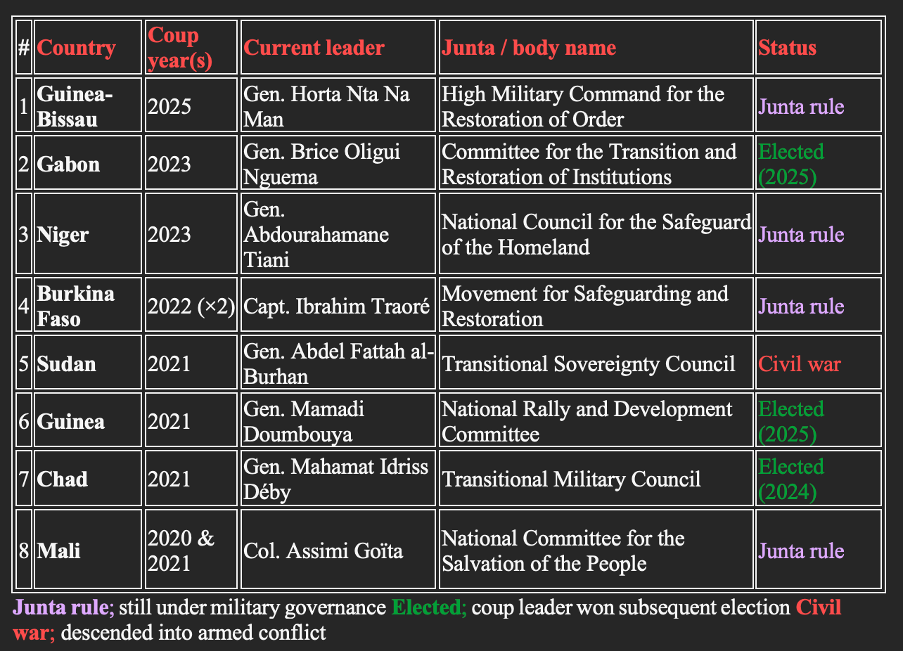
These cases illustrate a crucial point: while democratic forms persisted, their substance weakened. Citizens were not necessarily rejecting democracy as a principle; rather, they were losing faith in governments that claimed democratic legitimacy but failed to deliver meaningful outcomes. The result was a widening gap between state authority and public trust; a hallmark of a legitimacy crisis.
Patterns of Coups: Security, Elites, and State Fragility
To understand the current wave of coups, it is essential to recognise that not all military interventions are driven by the same motivations, and treating them as a uniform phenomenon obscures important differences.
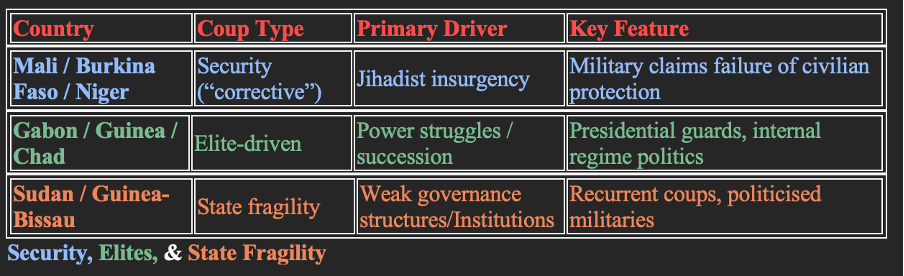
In the Sahelian states of Mali, Burkina Faso, and Niger, coups have largely been justified on the basis of deteriorating security stemming from jihadist groups linked to regional insurgencies, yet Governments were unable to protect their populations effectively. In this context, the military positioned itself as a corrective force, claiming that civilian leaders had failed in the most basic duty of ensuring national security. These so called “corrective coups” were often accompanied by rhetorics of national salvation and institutional reform emphasis. While such claims must be treated with caution, they resonated with segments of the population disillusioned with civilian rule.
By contrast, in countries such as Gabon, Guinea, and Chad, coups were driven primarily by elite power struggles and contested succession dynamics, with power seized by presidential guard units often better trained and equipped, and more politically connected than the regular army. These interventions were less about immediate governance failures. They are more about reshaping political control within ruling circles and often framed as necessary to restore democratic integrity or end corrupt regimes, allowing military leaders to justify their actions.
Meanwhile, in Sudan and Guinea-Bissau, coups reflect deeper institutional fragility, reinforcing OECD’s finding that countries experiencing high levels of political and institutional fragility are more prone to recurrent coups and unconstitutional power transitions. In Sudan, the military’s entrenched role in politics has contributed to cycles of instability and conflict, while Guinea-Bissau has long struggled with weak state institutions and repeated military interference.
Taken together, these distinctions reinforce the argument that coups are not simply anti-democratic acts. Rather, they are manifestations of different forms of governance breakdown, reflecting failures in security, elite management, and institutional stability. This brings attention to one of the most revealing aspects of recent coups which has been the reaction of ordinary citizens. In several cases, military takeovers were met not with widespread resistance, but with public demonstrations of support or resignation. In Burkina Faso and Mali, segments of the population welcomed military leaders, viewing them as potential agents of change. This does not imply an endorsement of authoritarian rule, but rather a reflection of frustration with existing governments. Where democratic systems fail to deliver, their legitimacy is called into question even if their formal structures remain intact. By contrast, in Sudan, public reactions have been more divided, with significant resistance to military control highlighting the importance of context: public attitudes toward coups depend on prior political experiences and expectations. Ultimately, public reaction serves as a critical indicator of legitimacy. If citizens perceive democratic governments as ineffective or corrupt, they may tolerate or even support extra constitutional interventions underscoring the central argument of this article: the crisis is not democracy per se, but the failure of governance.
The resurgence of coups has prompted strong responses from regional organisations, particularly Economic Community of West African States (ECOWAS). Measures have included economic sanctions, diplomatic isolation, and threats of military intervention, especially in response to events in Niger. These actions are grounded in a commitment to uphold constitutional order and deter future coups. However, these measures are debated to often harm civilians, strengthen military rulers, and fuel narratives of foreign interference raising a critical dilemma: enforcing democratic norms without addressing root causes such as poor governance can worsen instability. In this sense, the coups in Mali, Burkina Faso, Niger, and beyond are not the end of democracy in the region. They are a warning signal that democratic systems must evolve to meet the expectations of the people they are meant to serve. Only by closing the gap between democratic ideals and lived realities can lasting stability be achieved.