Africa’s governance story is one of striking contrasts. Large, economically and geopolitically significant states such as Nigeria, Egypt, Kenya, and South Africa continue to grapple with corruption, instability, and weak institutions that erode citizen trust and slow development. By contrast, smaller democracies like Seychelles, Mauritius, and Cabo Verde consistently top the Ibrahim Index of African Governance (IIAG). Crucially, this divergence is not inevitable.
The experiences of IIAG’s top performers show that meaningful change is possible even in constrained contexts, and that governance dividends accumulate over time. While Africa’s governance challenge is often framed as a problem of scale, the evidence reveals that some of the continent’s smallest states consistently outperform much larger and more influential ones. Thus, this article explores Africa’s governance landscape leveraging insights from the IIAG, and identify the lessons larger states that perform poorly on the IIAG can draw from its leading performers.
Insights from IIAG
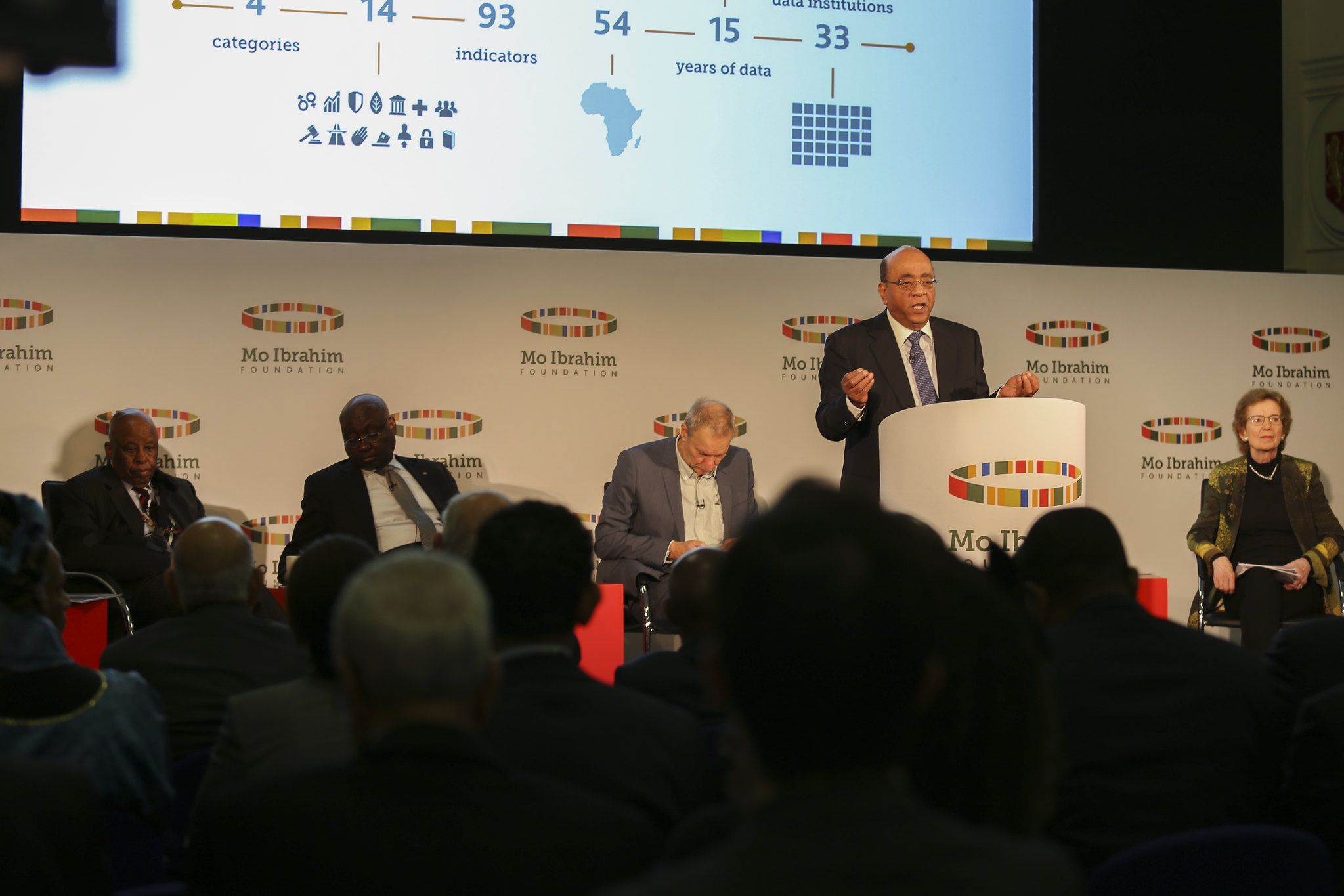
The Ibrahim Index of African Governance measures and monitors governance performance in African countries across four key components: Security & Rule of Law; Participation, Rights & Inclusion; Foundations for Economic Opportunity; and Human Development, with each containing sub-indicators offering quantifiable dimensions of governance in the provision of public goods and services to citizens.
Between 2020 and 2023, Seychelles, Mauritius, and Cabo Verde consistently ranked first, second, and third among the continent’s 54 countries. Their strong governance, high institutional quality, and adherence to the rule of law were reflected in their 2023 overall governance scores of 75.3, 72.8, and 69.6 out of 100, respectively.
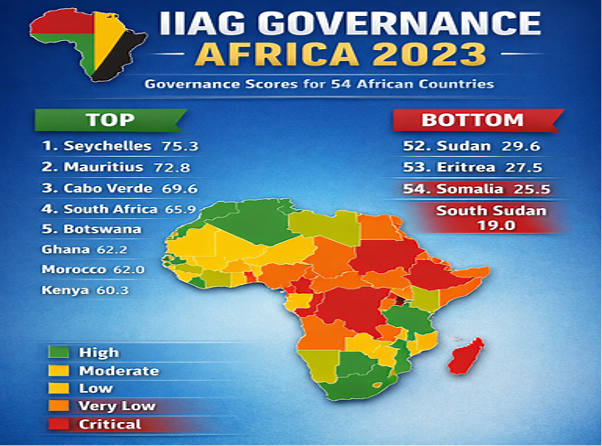
South Africa ranking fourth scored 65.9/100, while Kenya ranking tenth scored 60.3/100, coming after Botswana, Namibia, Ghana, Morocco, and Tunisia respectively. Egypt ranked 24th with 51.0/100, and Nigeria 33rd with 45.7/100. Closing the bottom of the index are Congo Republic, Libya, Chad, Central African Republic, Equatorial Guinea, Sudan, Eritrea, Somalia, and South Sudan, that ranked from 45th and 54th respectively. These comparative scores capture lived realities: the reliability of public services, credibility of elections, independence of courts, and the degree to which citizens trust the state.
Governance Gaps in Africa’s Largest States
In Nigeria, persistent corruption and transparency deficits undermine service delivery across all tiers of government. Security crises have weakened state authority, while disregard for constitutional norms and judicial independence erodes the rule of law. Economic mismanagement, overdependence on oil revenues and limited diversification has left the economy vulnerable, while elections marred by malpractice further weaken legitimacy.
Recurring financial instability has left Egypt reliant on international bailouts. Substantial state ownership and intervention crowd out private enterprise while authoritarian governance restricts civil liberties and political participation. Tourism and foreign investment remain highly exposed to regional instability and climate risks while narrowly avoiding a full-blown economic crisis in 2024.
Kenya’s governance is weakened by persistent impunity, erosion of constitutionalism, and corruption in procurement and service delivery. Civil liberties and political freedoms have regressed, with increasing restrictions on human rights. Power devolution while promising in design, struggled to deliver consistent accountability at the county level, leaving resource management and transparency uneven.
South Africa, despite strong formal institutions, continues to grapple with the legacy of state capture. Widespread corruption scandals, weak enforcement of accountability, unfunded budgets, and poor financial management have led to service delivery breakdowns. Public administration remains fragmented, with poor coordination and limited capacity at the local government level.
These governance deficits highlight the paradox of scale: African larger states often fail to convert economic and geopolitical weight into effective governance, leaving their IIAG scores behind smaller, more stable countries.
Governance Successes in Small States
Seychelles illustrates the power of aligning economic management with environmental stewardship to enjoy a comparatively high degree of economic stability. Leveraging its Blue-Economy strategy, IMF-backed reforms, and a comprehensive National Development Strategy (2019–2023), the country integrated marine conservation with economic growth. A pioneering debt-for-nature swap restructured national debt for marine ecosystem protection, positioning Seychelles as a global leader in environmental governance. Tourism and fisheries revenue funded universal healthcare, education, and social protection, strengthening social cohesion.
Mauritius offers a clear example of resilience built through diversification and democratic strength. Once dependent on sugar exports, Mauritius deliberately and successfully transitioned from a low-income into a diversified upper middle-income economy, anchored by financial services, ICT, and tourism. Open trade regimes, investment-friendly policies, and credible regulations attracted foreign capital leading to economic performance improvements as of 2021. Free & fair elections, judicial independence, and civil liberties reinforced legitimacy, while the UN Strategic Partnership Framework (2019–2023) aligned national priorities with the SDGs and Agenda 2063, embedding sustainability and inclusivity in governance.
Cabo Verde showed that transparency and citizen inclusion drive governance performance. Open government reforms and citizen participation strengthened accountability and reduced corruption risks. Access to information on spending, justice services, and partnerships with the EU GSP+ governance incentives and AfDB gave citizens a direct stake in governance while advancing human rights, gender equality, renewable energy, and social protection. Digital governance, participatory budgeting, and community consultations institutionalized citizen voice, ensuring governance was not only top-down but genuinely inclusive.
These cases show how small states, through deliberate institutional choices, outperformed larger peers in governance, proving scale and economic weight are not prerequisites for leadership.
Lessons for Africa’s Larger States
Despite their strengths, Africa’s top governance performers remain vulnerable: Seychelles’ reliance on tourism heightens climate risk, Mauritius faces inflation and tourism downturns, and Cabo Verde’s small island economy depends on aid and remittances. Despite vulnerabilities, their experiences offer enduring lessons.
- Institutional discipline, rule‑bound systems, independent courts, and merit‑based civil services anchors stability across political cycles.
- Transparency and citizen participation build legitimacy by reducing corruption and fostering trust.
- Inclusive growth through universal services, social protection, and gender equity strengthens the social contract.
- Sustainability, energy transitions, climate resilience, and stewardship of green and blue economies are survival imperative.
- An execution culture ensures good governance is delivered, with performance compacts and public scorecards turning promises into outcomes.
These deliberate choices enable states to govern through strong institutions, transparency, citizen trust, disciplined execution, and sustainable growth strategies.
Conclusively, Africa’s governance gap is not about size, wealth, or ambition, it is about choices. The IIAG shows that countries delivering trust, services, and resilience succeed by building institutions that constrain power, reward performance, and endure beyond political cycles. Those that fail pay the price in instability, weak legitimacy, and stalled development.
For Nigeria, Egypt, Kenya, South Africa, and others, the gap is neither structural nor inevitable. Seychelles, Mauritius, and Cabo Verde prove that even under constraints, disciplined institutions, transparency, and inclusion can produce durable results. Their success rests not on exceptional leaders, but on exceptional systems that make good governance routine.
Governance, therefore, is not determined by size or ambition, but by institutional choices, political discipline, and the capacity to execute reforms. Closing the gap requires moving beyond personality-driven politics. It demands rule‑bound institutions, genuine citizen participation, and relentless focus on outcomes. As fiscal stress, climate risk, and demographic pressures mount, governance is no longer secondary, it is Africa’s defining development choice. By embracing institutional discipline, transparency, inclusivity, and sustainability, even the most complex and resource‑constrained states can close the governance gap and deliver outcomes that strengthen legitimacy, resilience, and long‑term development.