
Somewhere in a compound in Southeast Asia, a university-educated young African is typing fraud scripts he never chose to write. At home, his mother has not slept since February. He answered an advertisement on his phone for a job that sounded the way dreams sound when you are hungry enough to believe them. This is the new shape of an old wound, and it is spreading across a continent we have convinced ourselves is rising.
Africa has always been a continent of movement. Migration is not a failure of belonging; it is among the oldest and most human things we do. What has changed is that the road has been weaponised, and our response has not kept pace. My argument is this: trafficking persists in Africa because we fight it at the end of the chain, at the moment of rescue, instead of governing the whole chain that produces it. That chain runs from the ungoverned road, to the algorithm that finds the vulnerable, to the money that makes exploitation pay, to a homecoming that too often abandons the survivor. Until policy follows both the person and the profit at every stage, we will keep rescuing people into the conditions that trapped them.
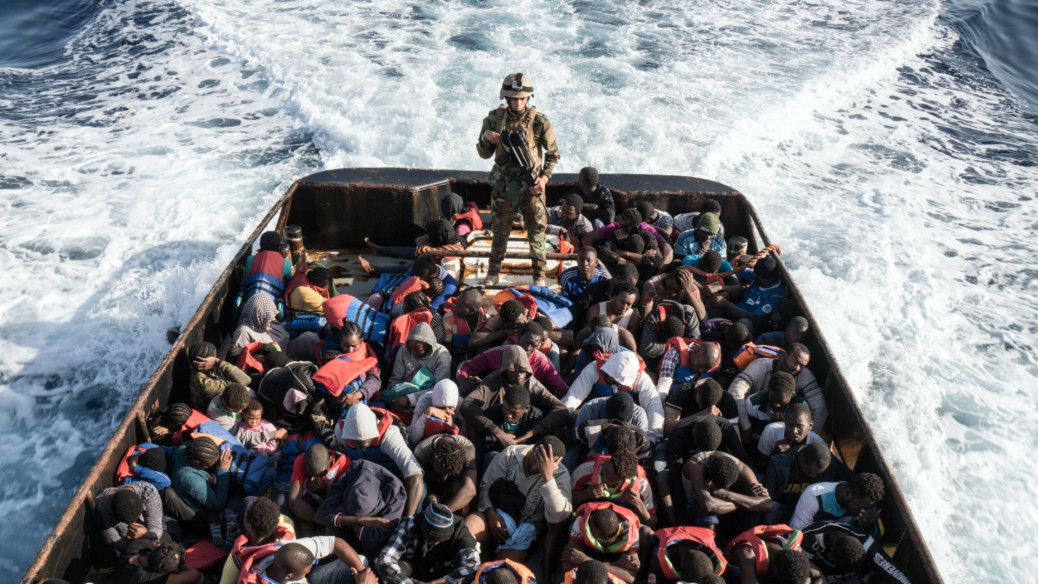
The first failure is the road itself. UNODC’s 2024 global report records a 25 percent rise in detected victims compared with pre-pandemic levels, and forced labour accounts for 80 percent of detected trafficking in East Africa. Our people are being taken primarily for work, not sex. Desperation is the raw material. Of the 12 million young Africans who enter the labour market each year, only three million find formal jobs, and in Uganda the informal sector accounts for 91 percent of employment. The trafficker does not create this desperation. He finds it, names it and sells it back to us, and he is usually known to the victim: the Freedom Collaborative found that in nearly three quarters of cases where the trafficker’s identity was known, it was a relative, friend, partner or acquaintance. Governments have responded with bilateral labour agreements and ministerial promises to negotiate with Gulf states as a bloc. Kenya, Uganda and Ethiopia have all signed such agreements with Gulf destinations, and the abuse allegations in Saudi Arabia that followed Uganda’s agreements show their limits. The Philippines is the reference point because it built the architecture most of Africa has not: a dedicated migrant workers department, mandatory pre-departure orientation, and labour attachés with real authority abroad. That architecture came from decades of pressure by families who refused to let governments look away. Meanwhile the IGAD Convention on Extradition has sat unsigned since 2012. The gap between a signed agreement and a protected worker is exactly where trafficking lives. These measures are fire brigades. We need urban planning.
The second failure is that the recruiter now works through the screen while our laws trail the technology. UNODC describes traffickers hunting for signals of vulnerability and fishing with bait calibrated by the platforms’ own data, increasingly using AI tools that manage hundreds of conversations at once, in many languages. By early 2024, mentions of deepfakes in trafficking and fraud contexts had risen 600 percent. Romance fraud is often the front door, and INTERPOL warns of chatbot-run profiles that build trust for weeks before extracting savings and, in the worst cases, freedom. Operation Contender 3.0, across 14 African countries, produced 260 arrests and identified 1,463 victims. In October 2026, a ten-country operation identified 117 people in Ghana who had been trafficked and held in scam compounds, while technology companies removed more than 3.7 million linked accounts, pages and groups. The screen conceals two victims at once: the person being defrauded and the person forced to do the defrauding. The loneliness is real too: young people arrive in Nairobi, Kigali or Lagos far from family networks, and go online because that is where connection now lives. The algorithm knows this, and the trafficker reads it as a targeting brief. African courts have begun to assert authority, from Kenya’s High Court accepting jurisdiction over a USD 2.4 billion suit against Meta to Nigeria’s fine of roughly USD 220 million on the same company. What is missing is the application of that principle to trafficking: digital safety education taught alongside digital literacy, mandatory platform accountability for recruitment content, and African states negotiating with Big Tech as a bloc rather than one by one.
The third failure is that we pursue people but not profit. The ILO estimates that forced labour generates USD 236 billion in illegal profits every year, about USD 20 billion of it in Africa, a figure it cautions is likely an underestimate. UNODC puts the global recovery rate for the proceeds of crime at under one percent. The criminal keeps ninety-nine cents of every dollar; the victim gets nothing. The money is washed through placement, layering and integration, with professional help from lawyers, accountants and developers. In 2024, more than half of the companies flagged for money laundering concerns by Kenya’s Business Registration Service operated in construction. Chainalysis reports that cryptocurrency flows to suspected trafficking services rose 85 percent in 2025. Informal value transfer systems such as hawala have long served legitimate remittance needs, so the task is to disrupt criminal use without treating a whole system as illicit. Kenya was greylisted by the FATF in February 2024 after it could not demonstrate a single successful money laundering investigation or prosecution, and it remains on the list in June 2026, alongside the Democratic Republic of the Congo and South Sudan. Its 2025 reforms carry the lesson: new laws are not the same as results. The continent needs shared beneficial ownership registries, harmonised regulation of virtual asset providers, enforceable cross-border asset recovery, and financial intelligence units equipped to trace funds across borders.
The fourth failure, and the quietest, is what happens after the person comes home. A 2025 PLOS ONE study of 350 female survivors in Kampala found that over 57 percent reported anxiety, 56 percent reported depression and 40.9 percent met the criteria for PTSD. Research from Ghana shows that physical health complaints do not peak at exit but increase over time, which means a support system built around the moment of rescue is built around the wrong timeline. One man returned from eight months in a scam compound, where beatings were calibrated to production shortfalls, and when people asked whether he had enjoyed working abroad, he said yes. It was easier than the truth. The journey home can wound further. Many governments in the region lack repatriation budgets, and some survivors plead guilty to immigration offences simply to speed their return, arriving home with records for crimes done to them. At home, stigma and family rejection can operate as a second exploitative system. The result is predictable: re-trafficking is common, and in the EHAAT dataset 61 percent of male clients had been trafficked before, against 36 percent of female clients, in a region where services are geared mainly towards women. Yet recovery is possible when we invest. HAART Kenya’s aftercare enabled 86 of 153 returnees to start small businesses, and a survivor summed up what dignified recovery requires in three words: seen, believed and supported.
Rescue is necessary, but it is not a strategy. Each failure feeds the next: an ungoverned road supplies victims, an unaccountable platform recruits them, an unchecked financial system rewards the crime, and an abandoned survivor returns to the vulnerability the trafficker first exploited. The remedy is to build the law that walks beside our people on the road: labour agreements with real teeth, platform liability backed by regional bargaining power, financial intelligence that follows the money across borders, and recovery funded for as long as it takes. Anything less leaves us counting rescues while the pipeline keeps running. The measure of every policy, prosecution and platform rule is not the number of cases we announce, but whether the people at the centre of them can live beyond what was done to them.
