

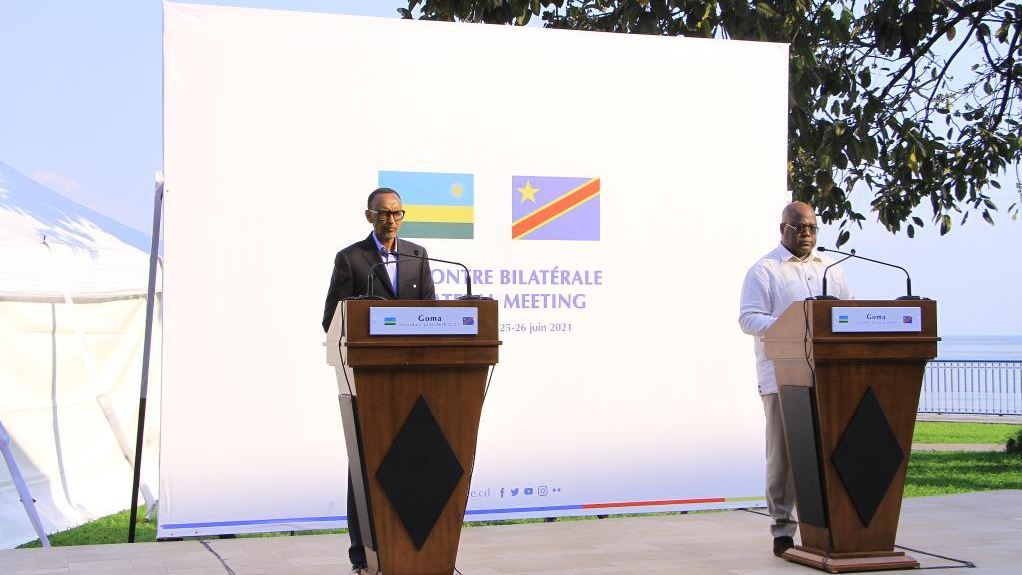
When Félix Tshisekedi became president of the Democratic Republic of Congo (DRC), little attention was paid to what may be the most consequential shift of his early years in office, i.e., a deliberate decision to normalize and institutionalize cooperation with Rwanda.
Between February and June 2021, the DRC and Rwanda signed a series of bilateral security and economic agreements that broke with decades of practice. For the first time since independence, Congo was not channeling its security and mineral policies through Western capitals and long‑standing Belgian networks. Instead, Kinshasa chose to work directly with a neighboring African state on the basis of shared interests. That choice is what became intolerable to certain Western and particularly Belgian interests.
It is precisely after this move toward regional autonomy that the narrative shifted. Once the accords were in place and began to be implemented, a new wave of discourse emerged from Kinshasa and from influential academic and advocacy circles in the West, framing Rwanda as an aggressor and engineering an “M23 crisis” as “proof” of Kigali’s supposed predatory intentions. Through a steady flow of reports, op‑eds, and briefings, these circles framed the situation as a story of Rwandan expansionism, offering talking points to Western policymakers who were uneasy about losing their central role in Congolese affairs. The timing and content of this discourse suggest that what was truly perceived as a threat was not Rwandan behavior, but the prospect of a Congolese–Rwandan partnership that would bypass traditional Western channels of influence.
To understand why, we have to recall the long Belgian shadow over Congolese gold and diamonds. Since independence, the DRC’s gold and diamonds sector has been organized largely through Western‑dominated circuits. Belgian religious orders and business interests played a central role, especially in South Kivu. The Catholic Church, with a strong presence of Belgian missionaries such as the White Fathers, or Pères Blancs, was not only a spiritual authority, but an important economic actor. From the early twentieth century onward, Belgian priests and their associates helped organize trade routes linking artisanal miners to European markets. Antwerp in Belgium emerged as a world capital of the diamond trade and cutting industry, despite the fact that Belgium has no natural diamond reserves of its own. Belgium’s position was built on gold and diamonds extracted in the Congo during and after the colonial period.
Local diggers in territories such as Mwenga extracted gold and other minerals. These were then passed along to first‑level refineries and artisanal workshops across the border in Rwanda. One of the hubs in this chain was the monastery of Gihindamuyaga, a faith‑based institution with a well‑established chaplaincy, retreat programs, and a reputation for making jewelry and metalwork from gold, silver, and copper, combined with locally sourced stones and wood. In practice, this meant that some Congolese ore was refined or transformed under the supervision of religious actors rooted in Belgian missionary traditions. From there, minerals could move through commercial channels, including Belgium’s national airline Sabena (Société Anonyme Belge d’Exploitation de la Navigation Aérienne), which became Brussels Airlines, and enter European refining and trading systems.
This pattern echoed the activities of larger Belgian enterprises such as Sominki (Société minière et industrielle du Kivu), which for years controlled mining concessions and export logistics from eastern Congo to Belgium. Congolese land provided the ore, Congolese and Rwandan workers provided the labor, and Belgian interests coordinated the profitable final stages of the value chain, enjoying favorable fiscal treatment and minimal scrutiny. Over time, this created a deeply entrenched structure in which external actors, not regional states, determined how Congolese minerals entered the global market.
By the late 1990s, political changes in the Great Lakes region began to disrupt these arrangements. The arrival of the Rwandan Patriotic Army in eastern Zaire/DRC in 1998 and the broader reshuffling of alliances weakened the Church‑linked and Belgian‑connected businesses in South Kivu. The White Fathers and their economic networks, including those linked to Gihindamuyaga, found themselves operating in a more contested environment. Not coincidentally, this period saw an intensification of anti‑Rwanda rhetoric from certain religious and political circles, as well as the rise of a Western policy discourse that presented Rwanda as the culprit behind Congo’s resource plunder. The loss of Belgian and Western control over specific mineral routes generated a need for new stories that diverted attention from those who had long benefitted from Congo’s wealth.
It is against this background that Tshisekedi’s rapprochement with Kigali must be understood. Facilitated by veteran security figures such as François Beya, who had served under Mobutu and Laurent‑Désiré Kabila before advising Tshisekedi, the new approach was based on a simple idea, i.e., put the past behind, build a pragmatic partnership, and do so without Western guardianship. In February 2021, senior defense and intelligence officials from the DRC and Rwanda met in Kigali and signed a Joint Security and Intelligence Operations Protocol. This framework established direct, real‑time intelligence sharing on armed groups operating in eastern DRC, especially the FDLR and the ADF, and laid out coordinated operations against these non‑state threats. Instead of casting each other as enemies, Kigali and Kinshasa formally acknowledged that their security was intertwined and that joint action would be more effective than unilateral moves or externally designed interventions such as “Umoja Wetu.”
Only a few months later, on 26–27 June 2021, Tshisekedi and Paul Kagame met in Rubavu and Goma and extended this cooperation into the economic realm. They signed an Investment Promotion and Protection Agreement to give Congolese and Rwandan investors reciprocal guarantees, a Double Taxation Avoidance Agreement to reduce fiscal barriers to cross‑border business, and, most significantly, a Memorandum of Understanding on gold mining and trade that linked the Congolese state enterprise Sakima SA with Dither Ltd, a private Rwandan company. Under this MoU, gold from Sakima’s concessions in Kivu and Maniema would be routed to Rwandan refineries such as the Gasabo Gold Refinery in Kigali. The goal was to establish a formal, traceable supply chain that would undercut smuggling networks which had long fed armed groups and foreign traders and to keep more of the added value in the region.
For the DRC, this promised increased fiscal revenues and a degree of control over a sector historically dominated by foreign intermediaries. For Rwanda, it secured a legal, predictable source of raw material for its refining industry. For both states, it was an assertion of their right to manage their own resources and security through African institutions, rather than through European or North American frameworks. Such a bilateral, state‑to‑state gold arrangement had never existed since independence. For decades, Belgium and other Western actors had been at the center of organizing and taxing the trade. Suddenly, two African governments proposed to “take things into their own hands.”
It is immediately after this turning point that the discourse about Rwanda changed dramatically. By late 2021 and into 2022, Kinshasa, under a mix of domestic pressures and external lobbying, began publicly accusing Rwanda of backing a “renewed M23 rebellion” and seeking to loot Congolese minerals. The Congo Research Group and its sister organization Ebuteli, under the leadership of American academic Jason Stearns, played a prominent role in consolidating and disseminating this narrative. Their publications and media interventions presented the crisis exclusively as proof of Rwandan aggression and framed Tshisekedi’s earlier overtures to Kigali as a miscalculation. In doing so, they lent an academic and “expert” veneer to a storyline that aligned closely with the interests of Western governments and Belgian‑linked networks anxious about being sidelined.
This sudden reversal raises obvious questions. Rwanda’s fundamental interests did not change overnight. The security protocol of February 2021 and the June economic accords were still in force or only just beginning to be implemented when the accusations took center stage. M23, for its part, was formally engaged in dialogue with Tshisekedi, and regional mediation was ongoing. What had changed, however, was the balance of influence over the DRC’s mineral and security agenda. By signing binding agreements with Kigali, Tshisekedi had signaled a willingness to reduce reliance on Western‑centric frameworks and to experiment with regional solutions. The bilateral gold arrangement, in particular, posed a direct challenge to networks with historical Belgian roots and contemporary Western backers that had long profited from Congolese exports, with little to no transparency.
Seen from this angle, the rapid construction of a new orthodox narrative by groups such as the Congo Research Group and Ebuteli appears less as a neutral assessment and more as a political intervention on behalf of those threatened interests. By insisting that Rwanda was “the villain”, these organizations helped create a discursive environment in which suspending or reversing the bilateral agreements could be portrayed as an act of “defending Congolese sovereignty,” rather than what it was: a way of maintaining space for traditional Western intermediaries and Belgian‑connected networks.
None of this denies the complexity of the situation in eastern DRC or the suffering of civilians. Rather, the point is that the way the conflict is framed matters. When analysts and institutions choose to start the story with alleged “Rwandan aggression” in 2021–2022, they erase the deeper history of who has controlled Congolese gold, who has benefitted from opaque supply chains, and who stood to lose when Rwanda and the DRC decided to cooperate on their own terms.
The 2021 agreements on security and gold represented a serious attempt to address two root causes of instability, armed groups and illicit mineral flows, through direct regional partnership. That experiment was cut short not because it was inherently unworkable, but because it threatened long‑entrenched Western and especially Belgian interests. The conflict in eastern DRC today is thus the product of carefully constructed narratives that penalize African efforts to chart a more autonomous course.
Understanding how the 2021–2022 Rwanda–DRC agreements were undermined is essential to recognize that genuine regional cooperation, rather than externally scripted stories, offers the most realistic path toward lasting stability in the Great Lakes region.

