

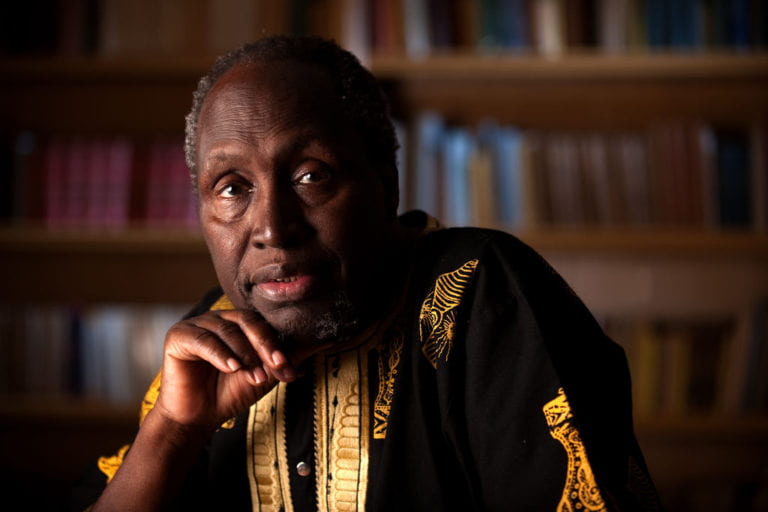
Exactly one year ago on May 28th, 2025, Professor Ngugi Wa Thiongo departed this earth. In a manner of scholarship uncommon in the era he lived, Wa Thiongo boldly identified and defined the reality of Africans living in a world that has consigned their knowledge to the periphery. Through his writings, teachings, and public speeches, Ngugi Wa Thiongo left behind countless transformed minds. His works continue to shape the work of present Africanist scholars who will pass that knowledge on to coming generations.
To some non-Africans and citizens of countries that were never colonized, discussing colonialism in the 21st century can seem like an abdication of responsibility for change; a case of blaming the past for one’s present self-inflicted troubles. Indeed, it presents serious difficulty for a mind unexposed to the crushing, suffocating impacts of knowledge colonization to understand its effects on the lived existence of its victims across generations.
It takes one who has sat in a classroom and been taught knowledge that is not only irrelevant to their own realities and environment, but dismissive and condescending of that reality, to understand knowledge decolonization. If you have not been conditioned by the formal education you were subjected to, to view your ancestry and indigenous knowledge as a wasteland filled with superstition and darkness, then the idea of knowledge decolonization will likely appear to you as little more than a distraction.
At the core of numerous of his works, Ngugi Wa Thiongo’s was concerned with emphatically declaring Africa’s intellectual dependence on others an abnormality. As simple as that sounds, it was a groundbreaking, emancipatory declaration in an age when intellectual dependency was celebrated by Africans and promoted by the rest of the world.
In Decolonizing the Mind, Wa Thiongo argues that decolonization is psychological and civilizational. He contends that Africa’s advancement can only occur when Africans end their intellectual captivity to foreign epistemologies. The liberation of Africa requires rediscovering confidence in African languages, cultures, philosophies, and indigenous systems of knowledge. Ngũgĩ’s assertion remains relevant today because in Africa, many societies still measure intelligence, modernity, and sophistication through proximity to Europe and North America.
In the book Petals of Blood (1977), sometimes considered Ngugi’s most intense take on African politics, he exposes how post-independence Kenya reproduced colonial inequalities. In the work, Ngugi critiques the inherited and continuing practices of land dispossession, corruption, the absence of national loyalty and the comprador capitalist inclinations of African elites. The novel links colonialism to capitalism rather than treating colonialism as merely foreign rule.
In Devil on the Cross, Wa Thiongo abandons the colonial linguistic framework he had long criticized. In seeking authentic expression for his thoughts, he writes the book in his native Gikuyu language (Caitaani Mũtharaba-Inĩ). In the book, Ngugi rejects the colonial literary assumption that “serious” African literature must be written in European languages and utilizes storytelling structures, songs, satire, and communal narration rooted in African traditions.
In Devil on the Cross, Ngugi Wa Thiongo shifts his gaze from the Global North to African elites who inherited the mantle of colonial exploitation after independence. The book was written while Ngugi was imprisoned by the Kenyan government. In the “Devil’s Feast” scene, corrupt business leaders and politicians gather to boast about their exploitation of the Kenyan working class. The most successful in stealing from the masses are highly celebrated by their contemporaries.
Almost fifty years after they were written, the messages in Petals of Blood and Devil on the Cross still ring true. Kenya and many African countries continue to experience bifurcated economies, with more citizens occupying the lower strata of the economic divide.
In Matigari (1986), Ngugi Wa Thiongo continues to question the real meaning of independence in the face of the continued oppression of Africans by politicians and elites across various African countries. The novel blurs myth, folklore, oral tradition, and realism in ways that reject European realist conventions. The book decolonizes African literary form itself by centering African oral-mythic consciousness.
Ngũgĩ wa Thiong’o lived through colonization, political independence, economic exploitation, and cultural dependence. He spent much of his life during an era when African children searched tirelessly for themselves in the pages of books, only to encounter blond-haired, blue-eyed characters with names they could only dream of adopting once they shed themselves of the “backward” culture to which they had been taught they belonged. Through secondary and tertiary education, African teachers taught from textbooks published by the offspring of former colonial powers. Research agendas were set in the Global North and executed in Africa by “experts” from the same geographical locations. Yet the world, including Africans themselves, did not recognize this cognitive injustice.
Yet, Ngugi Wa Thiongo was also privileged to live and witness what can be described as the onset of an era in which African countries are beginning to assert themselves economically, intellectually, and culturally on the global stage. The African Continental Free Trade Area (AfCFTA), the rise of economic powers such as Nigeria, South Africa, Kenya, and Ethiopia, the global popularity of Afrobeats artists like Burna Boy and Tems, the international success of African literature through writers such as Chimamanda Ngozi Adichie, and growing calls to repatriate African artifacts from European museums all reflect the gradual realization of the cultural and intellectual liberation Ngũgĩ advocated.
Ngugi Wa Thiongo also lived to witness the gradual, though still largely informal, decolonization of African education. This has taken the form of the unshackling of learning from Euro-American strongholds, occasioned by the knowledge liberalization heralded by internet penetration across Africa. More Africans are becoming aware of their miseducation, and there is hope that the continent will soon embark on a widespread reassessment of what education means for its various communities. Across the continent, renewed interest in indigenous languages, African-centered education, local manufacturing, Pan-African cooperation, and knowledge production outside Western frameworks suggests that Africa is slowly beginning to decolonize not only its politics, but also its mind.
Ngugi Wa Thiongo’s work is foundational to the transformation being experienced across Africa today. Through the internet, his speeches, book excerpts, and essays are more readily available to many. Scholars, researchers, and writers across disciplines and sectors continue to lean on his work, drawing from it a foundational basis for framing their convictions. His own works leaned on the shoulders of African and non-African decolonial scholars, including Aimé Césaire’s Discourse on Colonialism (1950), Albert Memmi’s The Colonizer and the Colonized (1957), Frantz Fanon’s Black Skin, White Masks (1952) and The Wretched of the Earth (1961), and Paulo Freire’s Pedagogy of the Oppressed (1968), among numerous others.
Ngugi Wa Thiongo’s intellectual legacy is also becoming increasingly visible in today’s digital knowledge revolution. Across Africa, podcasts, YouTube intellectual platforms, online universities, independent publishing networks, and local-language content creators are slowly breaking the historical monopoly Western institutions once held over the production and validation of knowledge. Young Africans are increasingly discussing history, politics, spirituality, economics, and philosophy outside traditional Eurocentric academic gatekeeping structures. At the same time, growing conversations around artificial intelligence and epistemic sovereignty are forcing the continent to confront an important question Ngũgĩ raised decades ago: who controls the language, memory, stories, and knowledge through which a people understand themselves? In many ways, the digital space has become the newest battlefield in the struggle to decolonize the African mind
The future is African. One in four people in the world by 2050 will be African. Western media often frames this demographic reality as a looming global burden. It is not.
Through Wa Thiongo’s work and the continuing work of many others, the emerging global landscape represents one in four emancipated African minds working across the world, contributing toward molding a future founded on respect for human and planetary life through the philosophy of Ubuntu. Professor Wa Thiongo’s place in shaping this future will not be forgotten; there is no questioning that Professor Ngugi Wa Thiongo’s name is carved in granite and will forever be counted among the builders of the new Africa.

