

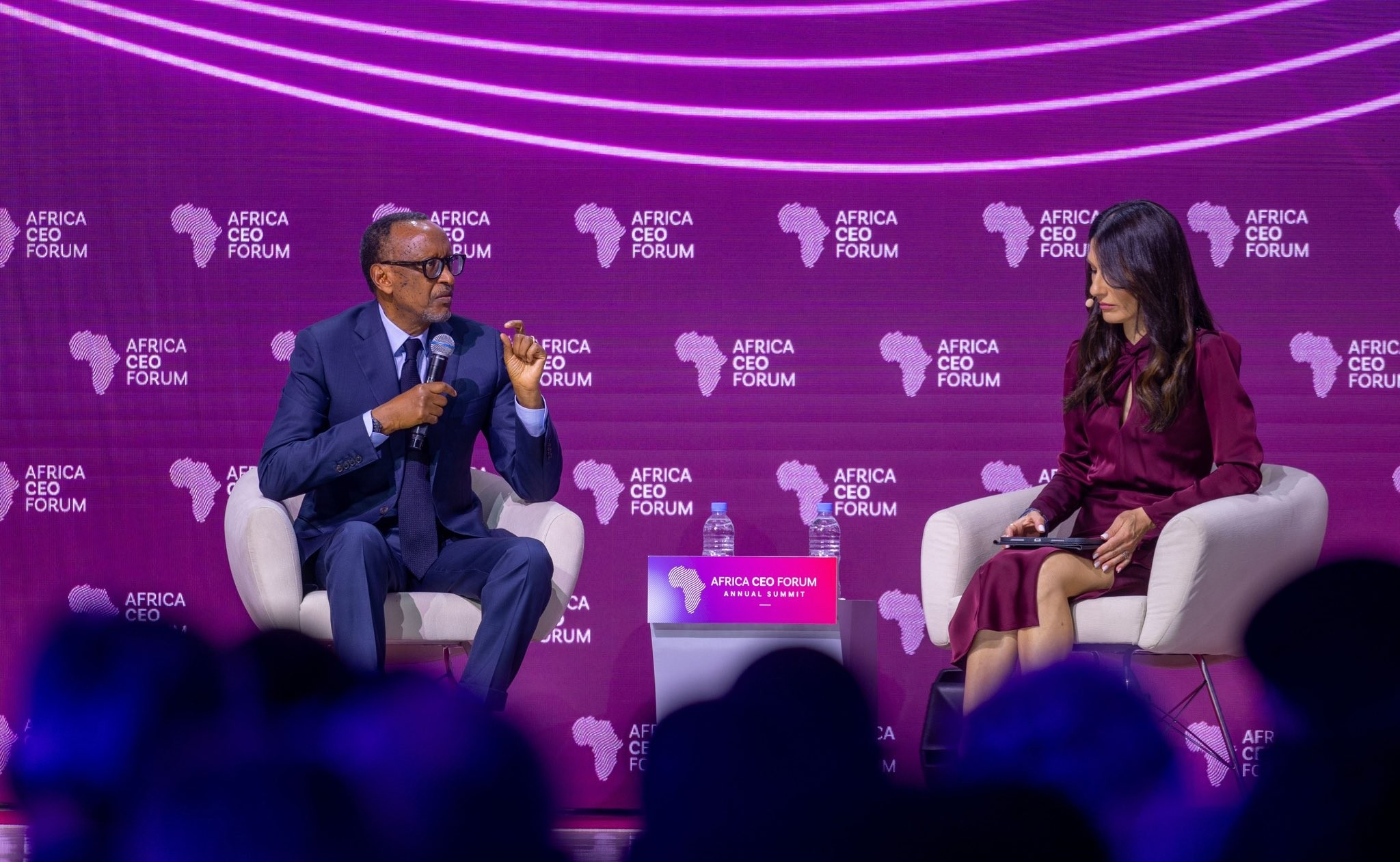
The 12th annual Africa CEO Forum was held on May 14–15, 2026, at the Kigali Convention Centre in Rwanda. The gathering brought together over 2800 business leaders, heads of state, and investors from 77 countries. On the agenda was scaling African companies, building regional alliances, and decreasing dependency on external financing.
Nigeria’s President Bola Tinubu didn’t hold back when he addressed the gathering on 16 May. He told the assembled captains of industry that it was time for African countries to “put [their] money where their mouth is” and trade more with each other.
This kind of rhetoric has been a mainstay of African development conferences for several years now. Yet serious regional trade integration remains elusive in much of the continent. After independence, the economies which Africans inherited were closely tied to those of their ex-colonial rulers and built to export commodities to the ‘home market’. What the continent lacked was a developed internal market to facilitate trade among its own economies.
Today, the holy grail of African development remains intracontinental economic integration. This means more regulatory alignment, more cross-border infrastructure, fewer tariffs, and greater supply chain entanglement.
This would strike at the fundamental problem of intracontinental connectivity. Africa’s transport networks are still so underdeveloped that the continent misses out on huge multipliers in economic activity from trade and travel.
Take air travel for example, where it is often cheaper to fly to another continent than between African cities. The continent is served by a very limited number of airlines and routes, while unhelpful passenger and airport taxes make flights unaffordable for many. For roads, the situation is even worse.
Cross-border trade is undermined by poorly maintained or missing highways to the extent that some states have had to take extraterritorial initiative. The government of Uganda for example has been forced to build roads inside the Democratic Republic of the Congo in order facilitate traffic with its biggest trading partner.
More fundamentally, the growth of an internal African market is essential for the continent’s economic prosperity. Exporter economies are otherwise subject to the constant fluctuations of global demand. If developed economies experience a downturn or an interest rate hike, African nations face a quadruple crisis of lower commodity prices, sliding demand, debt service costs and currency destabilisation.
The more Africa can develop its own continental supply-chains and markets, the more countries’ stability will reflect local conditions and not the vagaries of western central bank policy.
Cross-border trade is also hindered by a lack of specialisation, something ironically greater trade integration could fix. As African economies are dominated by agricultural goods, many countries produce the same products. Intra-African demand is ultimately undermined by the low industrial capacity and absence of specialisation of many countries. Ultimately, trade integration and industrialisation will go hand in hand in a mutually reinforcing cycle.
Africa’s situation has improved notably of late. In the late 1950s intra-African trade accounted for only 3% of the continent’s total trade. Today that figure is at 20%. Bilateral agreements, however, have proved notoriously difficult to finalise. Non-tariff barriers are often sources of prolonged contention while many states fail to act with the required urgency. In East Africa, the continent’s most promising region, progress is still slow.
One partnership leading the way is Tanzania and Kenya. Bilateral investment between the two countries exceeded $2 billion last year with cross-border trade set to exceed $1 billion. The pair recently announced a pact intended to deepen trade and cross-border cooperation. It included eight new cooperation agreements across energy, agriculture, railways, maritime transport, public service development and standards harmonisation. Crucially, the presidents of both countries also committed to the elimination of non-tariff barriers by June 2026.
President Samia Suluhu Hassan of Tanzania has been a particularly committed champion of bilateral trade liberalisation. Her decision to invite Kenya’s William Ruto came against a backdrop of political tensions between the two countries but reflected their leaders’ determination to push through these crucial reforms. This encouraging initiative takes place in the absence of similar initiatives between more aligned governments in the region, including in the East African Community.
Alongside the extensive agreements signed with Kenya, Tanzania has pursued further liberalisation with neighbours Zambia and Malawi. These agreements include harmonising fuel measurement standards through a mutual recognition agreement between relevant authorities; lifting a night travel ban in Zambia to allow 24-hour cargo movement; and eliminating duties between Tanzania and Malawi for goods below $2,000 to help small traders. This proactive initiative and speed of execution shows it can be done elsewhere.
Under President Samia, Tanzania has transformed from one of Africa’s most defensive economies, to a champion of regional trade and integration. The deepening economic cooperation between Tanzania and Kenya is a model for the rest of the continent. Bilateral trade last year was $860 million and is likely to surge under the latest deals. These also featured plans to construct the Malindi-Bagomoyo Superhighway and the restoration of the Voi-Taveta Railway to enhance the movement of goods and people between the two nations even further.
The template pioneered by Tanzania – focused on mutual recognition of certificates, tariff streamlining and reduction, non-tariff barrier elimination, bureaucratic simplification and transport infrastructure expansion – could serve as a model for piecemeal trade liberalisation across Africa. That’s at least one country putting its money right where it should be.

