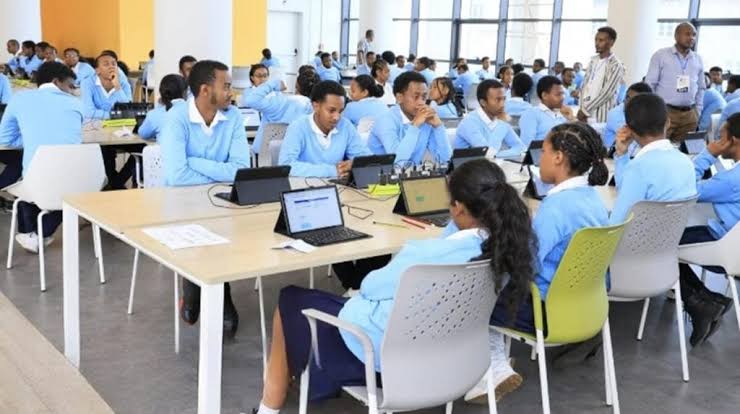
This year, of the 520,210 students who sat for the School Leaving Certificate examination, 70,554 (12.8%) passed, while 87.2% (453,623) didn’t; that’s 20,000 more than last year, when the pass percentage was 8.9%. In a country plagued by civil wars and with increased recruitment of new ones, at times forced, the most probable option for this huge number is to join the state military, non-state actors, or leave the country using risky routes. These figures indicate much more than exam results; they highlight years of failed policies and systemic failure.
Since taking office in 2018, Abiy has worked to undermine the Ethiopian People’s Revolutionary Democratic Front (EPRDF), the coalition that ruled Ethiopia from 1991 to March 2018. He has undermined EPRDF achievements and dismantled some of its policies; the education sector is one victim.
Before Abiy’s education reforms, in 2019, 233,102 (73,07%) of 319,264 students who sat for the exam became eligible to join higher institutions. Those who passed were accepted in government institutions where tuition is free; the remaining 86,162 could join private or government institutions on their own.
In 2026, the number of students sitting for the university entrance exam doubled compared with 2019, but failure rose by 60.2 percentage points or by 3.2 times. This year’s statistics also reveal deeper disparities. All students passed the exam in 88 schools, while none passed in 565 secondary schools. By region, Addis Ababa schools lead in pass % by 32,3, while Harari follows at 22,67. In absolute numbers, Oromia leads with 20,807 students who passed, while Addis Ababa follows with 18,664, meaning almost 60% of those who passed were from Oromia and Addis Ababa.
This may mean students in most schools in remote regions cannot get an opportunity to pursue a university degree, and that parents with resources may be able to send their children to elite schools where most students pass. This will create an imbalance of opportunities in the future, and widen the gap between the haves and the have-nots, something the EPRDF was keen to avoid.
Students in such a vast country who live in remote, conflict-affected, or poorly served areas must rely on schools that may lack qualified teachers, equipment, and regular instruction. Yet the students sit for the same examination despite twelve years of unequal education. These disparities require closer investigation.
The students are seen as having ‘failed’ their exams, with the blame placed on them. But failure of this magnitude cannot be explained by weak students and schools. An examination can highlight weaknesses, but it cannot diagnose a problem. The real failure may trace back to crowded classrooms, shortages of laboratories and textbooks, and unqualified or overburdened teachers. It may also trace back to communities disrupted by war and a top-down policymaking system. Such data is not evidence that the system has become more rigorous and successful. It shows a system that admits more young people into secondary education but leaves most of them without completing it. Ethiopia did not reach this crisis overnight.
During the Haile Selassie era, Educational policy focused on creating a group of skilled workers and administrators, while universal education was neglected. Ethiopia had a small, geographically uneven modern education system. The system disproportionately served towns even though roughly 90% of Ethiopians lived in rural areas. The language of instruction was Amharic. Tertiary education was limited.
Education expanded under Ethiopia’s Derg government (1974–1991), especially during its first decade, but access grew much faster than quality, which later stagnated due to war and famine. Tertiary education enrollment increased from approximately 5,900 university students in 1973/74 to nearly 18,000 in 1985/86, yet tertiary education still reached only a tiny fraction of Ethiopians. A nationwide literacy campaign was taught in about 15 languages and reached close to 20 million, though its quality was disputed.
When the Derg fell in 1991, the country had only two universities and five institutes and colleges. By 2018, it had 48 public universities distributed across the regions and another 128 accredited non-governmental higher-education institutions. Gross tertiary enrolment rose from about 0.83 per cent in 1991 to 10.43 per cent in 2018.
Education has expanded considerably across all levels and regions of Ethiopia during the EPRDF era. In 1994, Ethiopia introduced tuition-free basic education, adopted local languages for primary instruction, and clearly divided education responsibilities among the federal government, regions, woredas (districts), and schools. Each region has at least one university except the Harari region. But this expansion has come at the cost of quality. Private universities mushroomed, and some conferred degrees without proper education to attract students and make more money, treating education as a commodity. Students became obsessed with getting degrees at any cost because they helped secure employment. A staff member at one of those private universities recalls that students from the Somali region, in particular, were given nursing degrees without taking the necessary courses. Some others paid instructors to get better grades. One can imagine the consequences if such graduates join the health services. It can place lives and future generations at risk.
The EPRDF brought campuses closer to communities previously excluded from higher education, created opportunities outside the capital and trained a new generation of professionals. Whatever its other failures, the EPRDF understood that regional access to education mattered politically and socially.
The collapse did not begin with the latest examination reforms. Government planning documents had acknowledged shortages of trained teachers, textbooks, classrooms and laboratories before the current wars. Then COVID-19 disrupted learning.
The civil wars in the country had a devastating effect on education. According to UNICEF, by December 2022, an estimated 2.3 million school-aged children in Tigray had been denied their right to education for three academic years because of the conflict and COVID-19. In Afar, 37,740 children remained out of school for more than a year due to conflict. By early 2023, over 9,000 educational establishments across Tigray, Afar and Amhara had been damaged, destroyed or occupied by both IDPs and military groups. Teachers were killed or fled from conflict areas; children were displaced with their families. Conflict subsequently intensified in Amhara and continued in parts of Oromia. The shortage of quality has many reasons, and the answer is not mass exclusion. Policies to reform the system should have included all the stakeholders, not just the prime minister and his education minister.
Another UNICEF report estimated in June 2024 that approximately 17 million Ethiopian children, from pre-primary to junior secondary level, were out of school, nearly half of them girls. It warned that another 3.5 million primary and secondary school children were at risk of dropping out.
The effects of war on education have long-term impact even after the guns are silenced. Schools can be rebuilt, but students and teachers will be left with trauma affecting their performance for years. Students forced to be away from school may never return. Girls in particular face higher risks such as sexual violence and may be forced to marry at an early age. Every prolonged conflict creates an educational debt that the country will have to repay for decades. Peace is the first prerequisite to have an elaborate and functional educational policy. A government cannot claim to modernise its universities while allowing war to empty schools, displace teachers and consume resources needed for reconstruction.
Abiy Ahmed entered office promising reform, national unity and modernisation, but abandoned them when he consolidated his power. He also arrived with unusual confidence in his command of almost every subject. Military officers have been lectured on warfare, physicians on neurosurgery and university leaders on the mission of higher education. He also vowed never to build a university during his tenure. Though he has recently said that he will build an AI university. He has built many lodges, built museums and modernised the capital and other cities, displacing people from their homes and erasing their memories without compensation. The Prosperity Party (PP) that he formed and its policies now fall under his absolute power.
Abiy can also claim credit for recognising the importance of digitalisation, technology and modern warfare using drones, but those have been used indiscriminately in the simmering conflicts inside the country. Ethiopia’s public events increasingly present one chair, one microphone and one authoritative voice. Ministers, academics and professionals are too often reduced to an audience.
Education cannot be repaired in this manner. It requires analytical data to reach to the bottom of the problems, consultation with high school teachers, university lecturers, administrators, students and regional officials, independent research, and increased financing. All stakeholders need to own the reform process, not just watch it from the sidelines. The government is correct that previous national examinations may have suffered from cheating and inflated marks. Moving candidates to university campuses and tightening supervision made malpractice more difficult. A credible examination is essential. When 95 or 97 per cent of candidates fell below the threshold in recent years, it suggests the state guarded the exam paper well but failed to prepare most students. Those results could also be compared with those of relevant countries.
Ethiopia and Egypt are Africa’s second- and third-most populous countries and are bound together, often contentiously, by the Blue Nile. Ethiopian elites frequently compare their country with Egypt in military strength, infrastructure and development. Higher education offers another point of comparison, not because Egypt is free of inequality or quality problems, but because its recent direction differs markedly.
According to Egypt’s Ministry of Higher Education, the number of universities increased from 56 in 2013 to 129 in 2026. The system also includes more than 200 higher-education institutes and hosts about 195,000 foreign students. Between 2018 and 2024, approximately 3.5 million students graduated from its universities; including institutes, academies and technical institutions raises the figure to about 4.72 million.
Based on data from the World Bank and UNESCO, the global gross enrollment ratio for tertiary education stood at 43% as of 2023. In Organisation for Economic Co-operation and Development (OECD) countries, 48% of 25- to 34-year-olds held a tertiary degree in 2024. In Sub-Saharan Africa, the figure was 9%; Ethiopia’s was 8%, while Egypt’s was 38%.
Numbers alone do not prove quality, and Egypt’s system has its own shortcomings. Ethiopia’s earlier experience already demonstrated that multiplying institutions without adequate staff and standards can weaken education. But the comparison is telling. During the same eight-year period in which Egypt broadened and diversified its higher-education system, it trained a more specialised workforce, while Ethiopia moved from imperfect expansion to mass rejection at the university gate. The value of higher education can not be underestimated.
UNESCO describes higher education as “a rich cultural and scientific asset” that enables personal development and promotes economic, technological and social change. Universities train doctors, teachers, engineers, and researchers that the country needs for its development. They produce knowledge, preserve culture, strengthen institutions, and build the capacity to confront national problems.
Ethiopia therefore faces more than an examination crisis. It faces a national educational emergency. The immediate response should include remedial and bridging programmes for unsuccessful candidates, along with credible technical and vocational routes. It also needs to support teachers, invest in the weakest schools, and transparently analyse why hundreds of schools failed all their students. Universities need autonomy and proper quality assurance. Conflict-affected regions require reconstruction on a scale beyond the damage. Above all, institutions and professionals capable of investigating root causes must shape educational policy, not individuals who rubber-stamp whatever comes from higher authorities.
A country does not modernise by embarking on grand projects while its classrooms remain unchanged. It does not build unity by allowing geography and family income to decide who enters university. It cannot declare hundreds of thousands of young people failures when it has denied many of them books, teachers, functioning schools, and, most of all, peace.