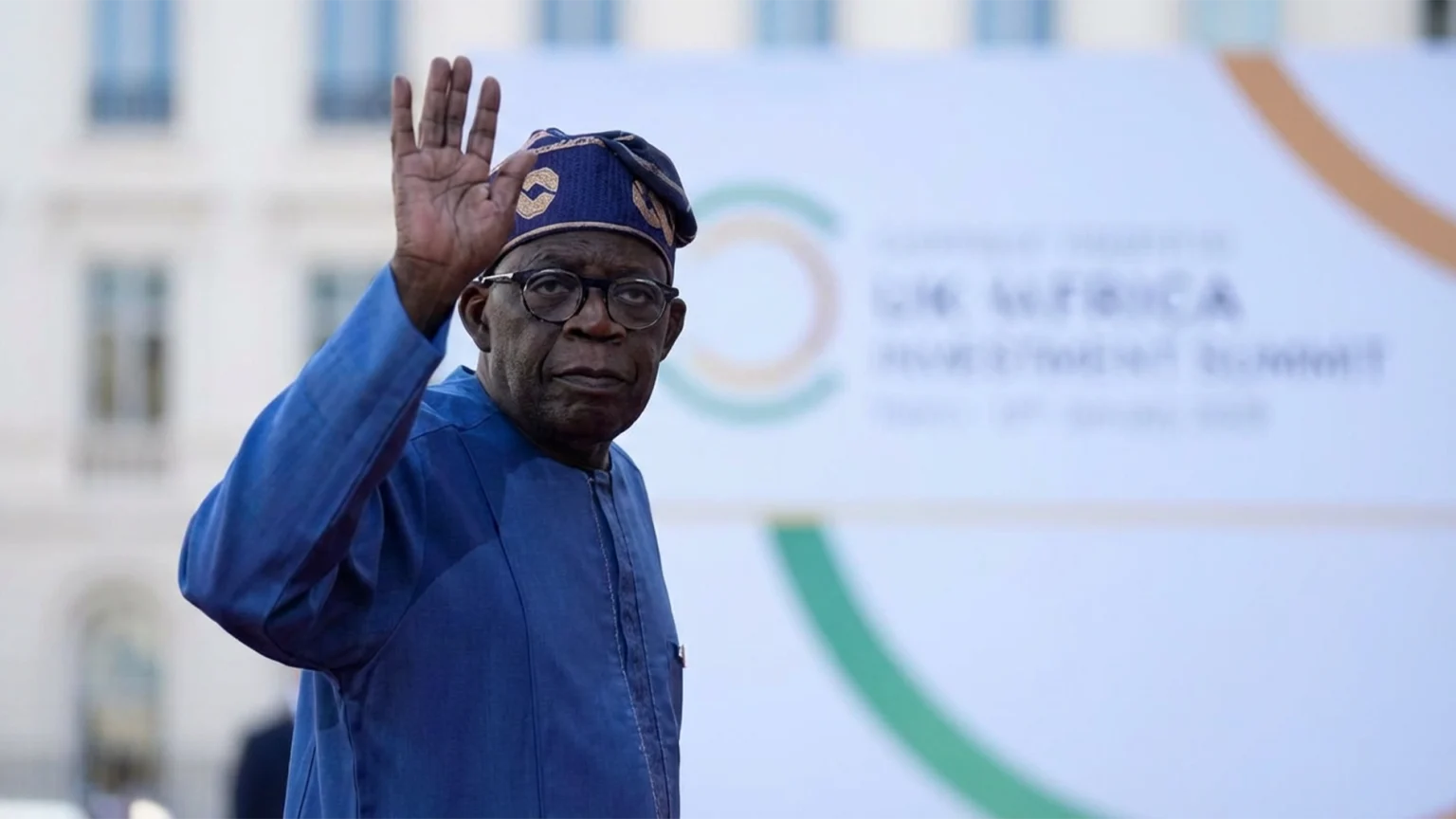
A president’s health is treated as a private matter until it raises doubt about the capacity to govern. At that point the line between personal privacy and public interest blurs. Nigeria has reached that point again. Fresh footage appears to show President Bola Tinubu stumbling as he approached his vehicle after an APC rally in Akwa Ibom. The clip has revived the question of whether a 74-year-old president should be asking for another four years. The incident deserves neither sensationalism nor dismissal. Age alone is not a disqualification, and a video cannot establish incapacity. What makes the question legitimate is the recurrent pattern, and the way the presidency addresses it.
In January 2026, despite falling over at a reception ceremony in Turkey, an aide said he was “in great shape” and attended his schedules. Other official explanations blamed a poorly laid blue carpet and a metal object underfoot. In June, another clip showed a loss of footing as he boarded a presidential parade vehicle ahead of Democracy Day celebration, and the presidency’s spokesman drew parallels with stumbles by Biden and Obama. Each explanation may be true. Nonetheless, repeated incidents, met with differing explanations and no independent medical information, leave citizens, financial markets, investors and civil servants guessing.
Joe Biden’s case shows what a political system can do when doubts become impossible to ignore. After his poor debate performance against Donald Trump in June 2024, anxiety about his age and communication spread through the Democratic Party. On July 21, 2024, at 81, he ended his re-election bid and endorsed Kamala Harris. The pressure came from lawmakers, donors and supporters. He was never medically declared incapable. He stepped aside because the people around him forced the question and he accepted the political verdict. The outcome was far from perfect. Harris lost in November, with Trump winning 312 electoral votes to her 226, and critics still argue the withdrawal came too late for a real contest. But the mechanism worked in public view. A party examined its own candidate, the candidate yielded, and the transition happened without crisis. Compare that with Tinubu’s position. The APC has lined up behind him with overwhelming support, and there is no visible internal reckoning of the kind that reached Biden. The presidency’s instinct has been to deny and deflect rather than reassure with evidence.
Paul Biya sits at the opposite end of the spectrum. At 92, he brushed off health fears to seek a new term. He was declared winner of Cameroon’s October 2025 election with 53.66% of the vote against Issa Tchiroma Bakary’s 35.19%. The opposition rejected the result, the Constitutional Council ruled it final, and protests continued across the country. Tchiroma refused to file a complaint with the Council because its judges are appointed by Biya. The Council dismissed the eight complaints that were filed, and the protests left people dead and more than 1,200 arrested, according to the National Human Rights Commission. He was sworn in on November 6, 2025 for seven more years, which would carry him to nearly 100. He has ruled since 1982, and Cameroon’s parliament removed the presidential term limit in 2008. The lesson from Cameroon is not that old leaders must retire. It is what happens when no party, court or legislature can ask whether a president is fit. Authority becomes so personalised that succession stops being an ordinary constitutional event and becomes a national risk. Everyone knows the question will eventually be answered. Nobody is allowed to ask it in the meantime.
Tinubu’s comparisons in both directions are instructive. Unlike Biya, he operates under a constitution that limits presidents to two elected terms, so indefinite incumbency is impossible. He is also eligible to run, and nothing in his eligibility is in doubt. The constitution even contains a procedure for presidential incapacity, though it is a last resort that nobody is seriously proposing. Unlike Biden, however, he faces no equivalent internal check. The question has been left to the electorate and to the media, while the presidency treats each incident as mischief. Eligibility is not the same as demonstrated fitness. A candidate can be fully entitled to seek a second term while the country remains entitled to ask whether he can serve it.
This is where the debate becomes economic. Presidential capacity is not about ceremonies or speeches. It is about the daily work of coordinating a government: chairing the decisions that move budgets, settle disputes between ministries, reassure creditors and keep reforms on track. Nigeria needs that work done at a demanding moment. Since subsidy removal and the wider 2023 reforms, households have faced a punishing cost-of-living squeeze, and debt servicing absorbs a large share of government revenue. In January 2026 the National Assembly repealed and re-enacted the 2024 and 2025 budgets, an unusual step that shows how badly fiscal alignment had slipped. The IMF’s 2026 Article IV assessment acknowledged strong reform progress but flagged off-budget spending and complex financing instruments. It called for tighter budget processes, public financial management, fiscal reporting and transparency. Those are executive problems. They require a president who can set priorities, enforce disciplines, and be seen to be in charge. When doubt hangs over a presidency, the costs are rarely dramatic. They accumulate quietly. Economic decisions are delayed, and policies become inconsistent. Investors price in additional risk, and officials hedge their bets rather than commit. Political succession manoeuvres, which begin early whenever a leader’s future is uncertain, divert governance attention. Accountability slips, and administrative decisions begin to reflect political calculation rather than public interest.
None of this is inevitable, and none should be pinned automatically on a president’s age or health. The effects include likely weak institutions, and personalised authority, which is exactly why Biya’s Cameroon matters as a warning. Biden’s America matters as the opposite signal. Its markets and institutions absorbed a late and messy transition because the system could ask hard questions and act on the answers. Nigeria’s economy cannot afford a drift into the Cameroonian pattern, in which uncertainty is suppressed until it cannot be managed. The 2027 election is the moment to raise the conversation above party loyalty. The real choice is not whether Tinubu may run, because he plainly is. It is whether Nigeria’s institutions will behave more like America’s, where concern became a process, or more like Cameroon’s, where concern became a taboo. There are practical steps that do not require insulting anyone. The presidency can offer credible, independent medical disclosure. It can be clear about who exercises authority when the president is away or unwell. Party members and legislators can ask the question openly rather than whisper it.
A presidency is not a retirement entitlement, a personal possession or an inheritance. It is a demanding public trust. Biden eventually recognised that his party and the country needed renewal. Biya never allowed the question to be raised. Tinubu has yet to show which path he will take. In an economy under fiscal strain, with borrowing high and reforms unfinished, the cost of leaving that question unanswered could be significant. Presidential fitness is not ultimately about age. It is about capacity, responsibility and the national interest.