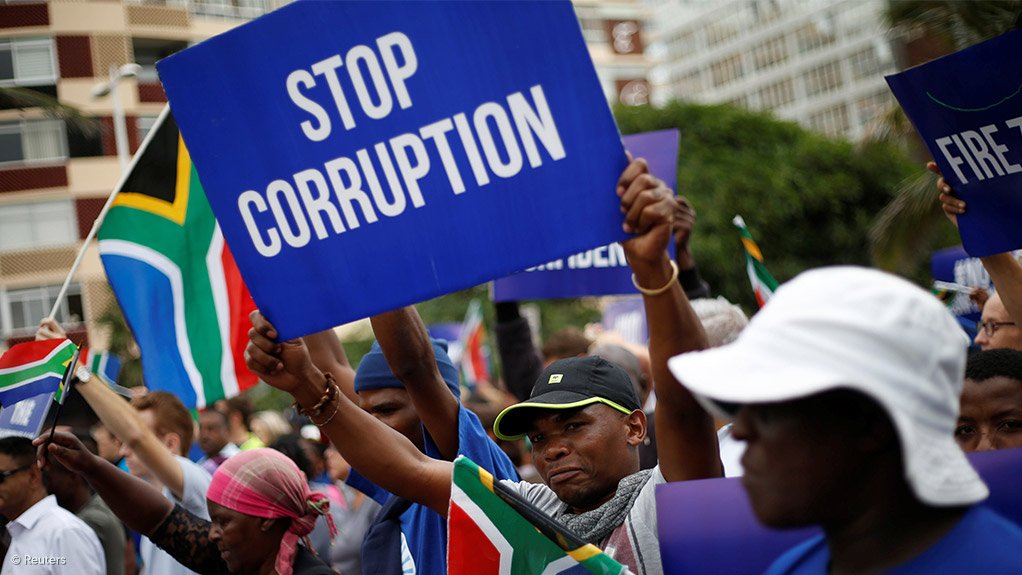
In most African countries, anti-corruption institutions struggle to remain independent, especially in dominant-party systems. Anti-corruption bodies are only as independent as the political systems in which they operate. In dominant-party states such as Nigeria and South Africa, formal legal mandates and constitutional protections have proven insufficient to shield institutions like the Economic and Financial Crimes Commission (EFCC) and the National Prosecuting Authority (NPA) from executive interference and ruling-party interests. When Nigeria’s President Bola Tinubu suspended EFCC chairman Abdulrasheed Bawa in June 2023, less than a month after assuming office, it was not an isolated incident. His predecessor, Muhammadu Buhari, similarly suspended Ibrahim Magu in 2020. In South Africa, the architects of state capture spent nearly a decade weakening the very institutions designed to hold them accountable. Across both countries, the lesson is clear: anti-corruption bodies may be created by law, but they cannot be protected by law alone.
This policy brief argues that institutional independence is not a fixed condition but a contingent one emerging during periods of intra-party rivalry or heightened public pressure, and receding when political control consolidates. Drawing on a comparative analysis of both countries, it identifies the structural conditions that enable or undermine anti-corruption effectiveness and proposes five concrete reforms to strengthen anti-corruption governance.
Anti-Corruption under Dominant-Party Rule: Nigeria and South Africa
In dominant-party systems, the independence of anti-corruption institutions is shaped less by legal frameworks than by political reality. Though such systems may appear electorally competitive, prolonged single-party dominance allows ruling parties to exert pressure on oversight bodies, creating a persistent gap between formal protections and actual practice. True independence must therefore be understood in both de jure (legal safeguards) and de facto (actual practice) terms, and the distance between the two is often vast.
South Africa and Nigeria illustrate this dynamic with particular clarity. The ANC has held continuous national power since the end of apartheid, while Nigeria, despite formal multiparty competition, has exhibited enduring elite dominance across electoral cycles. Both countries have established anti-corruption institutions with meaningful legal powers. Both have also seen those powers bent by political will.
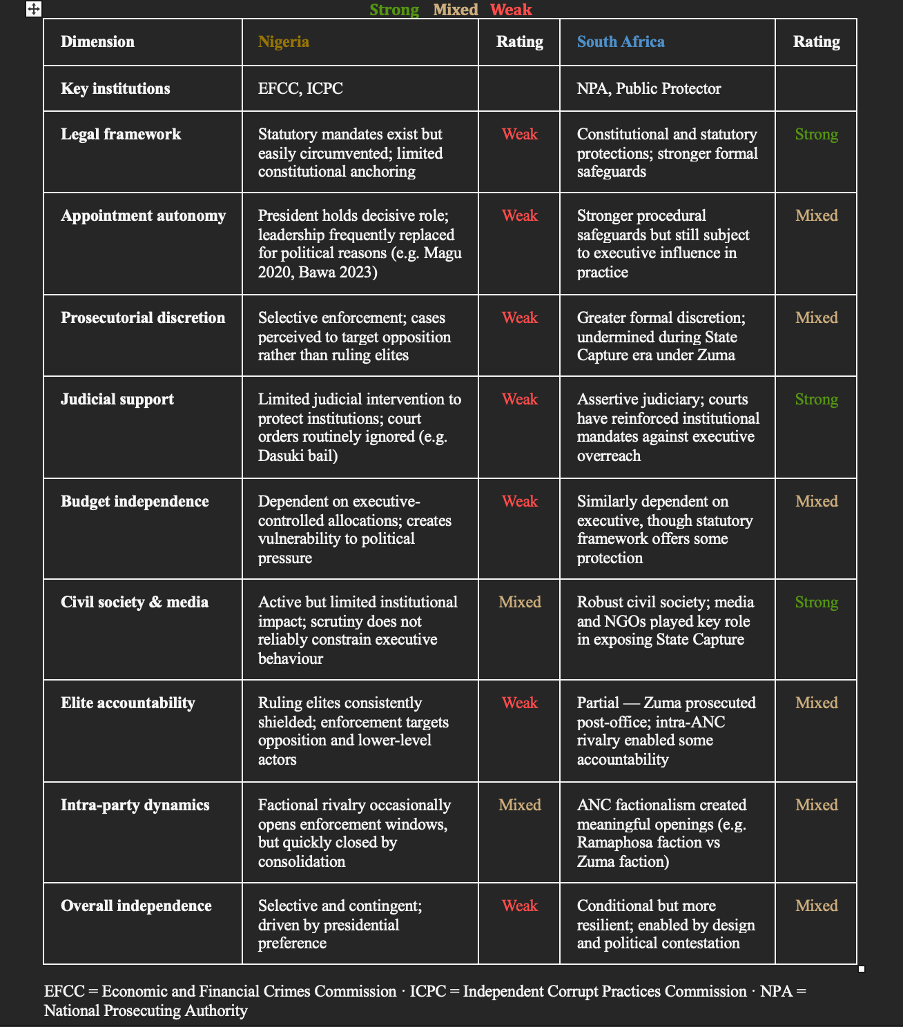
In Nigeria, the EFCC and ICPC hold broad investigative and enforcement mandates. In practice, their independence is uneven and politically contingent. Appointment processes remain dominated by the executive, incentivising alignment with ruling-party priorities. The pattern is starkly illustrated by the abrupt removal of EFCC heads Ibrahim Magu in 2020 and Abdulrasheed Bawa in 2023; both dismissed by sitting presidents, signalling how quickly institutional leadership can be reshaped by executive authority. Enforcement patterns reinforce the same concern. Under President Buhari, the prolonged detention of Sambo Dasuki, despite multiple court-ordered bail rulings, along with the perceived targeting of opposition-linked figures, drew sustained criticism. Similar accusations have followed under President Tinubu with the detention of Nasir El-Rufai. These episodes do not erase genuine enforcement efforts, but they reveal an institution whose autonomy is activated selectively and deployed when politically useful, and constrained when inconvenient.
South Africa presents a comparatively stronger institutional design. The NPA and Public Protector benefit from constitutional protections, greater security of tenure, and the backing of a more assertive judiciary. These features have enabled real moments of institutional courage, most notably when Thuli Madonsela’s “State of Capture” report exposed systemic corruption under Zuma despite fierce political resistance. Yet South Africa equally demonstrates the limits of formal protections. During the Zuma years, the NPA suffered leadership instability and politicisation that crippled its ability to pursue high-level cases consistently. What permitted institutional resilience was not design alone, but intra-party factional conflict, rival ANC factions using anti-corruption mechanisms against one another, creating openings that structural rules alone could not have generated.
This is the central insight both cases share. Independence is not guaranteed by founding legislation but emerges through political competition, judicial assertiveness, civil society pressure, and elite calculations. Autonomy in appointments, budgets, and prosecutorial discretion strengthens anti-corruption bodies only when the broader environment permits. Without it, independence remains formal; with it, even constrained institutions can hold power accountable.
Limits of Institutional Independence under Dominant-Party Rule
Anti-corruption bodies in Nigeria and South Africa share a fundamental paradox: formal independence exists in law but is routinely constrained by executive influence and ruling-party interests. Despite differences in institutional design, both countries reveal the same structural pattern, legal mandates are insufficient without a supportive political environment headed by the leadership of the executive arm of government. A key weakness in both systems is executive control over appointments. Though governed by legal procedures, leadership selection in practice reflects presidential or dominant-party preferences, embedding implicit expectations of political loyalty that compromise enforcement from the outset.
Prosecutorial politicisation compounds this problem. Nigeria’s EFCC has frequently been perceived as selectively targeting opposition figures, while South Africa’s NPA has faced allegations of inconsistency driven by intra-party pressures. In both cases, formal discretion exists but is exercised according to political calculations determining which cases advance, stall, or disappear. This feeds a broader tendency to shield ruling elites from accountability, with lower-level actors prosecuted while influential figures remain protected.
Despite these convergences, significant differences exist. South Africa possesses stronger legal safeguards and a more assertive judiciary, enabling institutions like the Public Protector to challenge executive overreach at critical moments. Nigeria, by contrast, exhibits more overt executive control, with weaker judicial intervention leaving institutional autonomy more directly dependent on perceived presidential preferences. In both countries, moments of genuine enforcement tend to emerge from intra-party competition, civil society pressure, or media scrutiny, not from institutional design alone.
This article highlights five priority reforms to strengthen anti-corruption governance. First, although appointments remain executive-led under the Economic and Financial Crimes Commission (Establishment) Act 2004 and National Prosecuting Authority Act 32 of 1998, legislatures should play a more substantive role through transparent, multi-stage selection processes in Nigeria and strengthened parliamentary oversight alongside fixed, non-renewable terms for leadership in South Africa. Second, oversight should be institutionalised across multiple actors, building overlapping accountability channels across judiciaries, parliaments, ombudsmen, and finance ministries, with codified obligations to share evidence across bodies. Third, financial autonomy must be secured through multi-year, legislatively approved funding frameworks. Fourth, civil society and investigative journalism require stronger legal protections, including effective whistleblower regimes. Fifth, regional and international mechanisms particularly the United Nations Convention against Corruption and the African Union should reinforce domestic reforms by linking external support to demonstrable progress in institutional independence.
In conclusion, anti-corruption institutions in dominant-party systems fail not because of poor design but because design cannot override the political incentives controlling appointments, budgets, and prosecutions. Both Nigeria and South Africa have produced moments of genuine accountability, yet independence remains contingent, activated by rivalry or public pressure, suppressed when ruling-party interests align. The reforms proposed address this structural vulnerability directly. For policymakers across Africa and beyond, the lesson is clear: invest not only in anti-corruption institutions, but in the surrounding ecosystem of judicial independence, legislative oversight, and civil society freedom that determines whether those institutions can actually act. Where that ecosystem is weak, formal independence will remain a legal fiction.