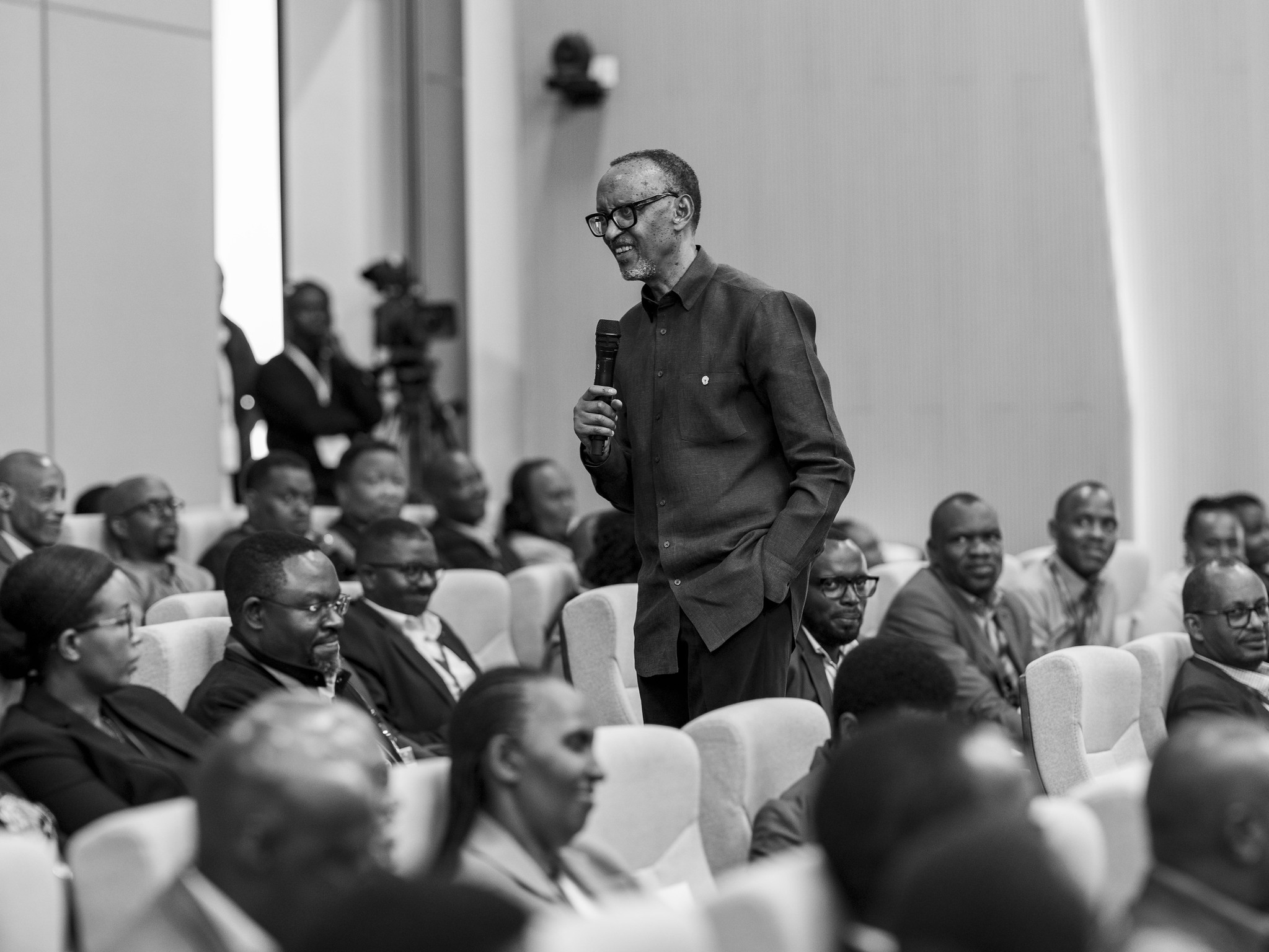
Yesterday, the government of Rwanda held what used to be its annual retreat. The last time it was held was in 2019; it was put on hold during the Covid pandemic—until now.
President Kagame was tough on government officials, many of whom remain oblivious to the civilisational mission of the liberation struggle—something I will return to shortly. It seems his starkest warning—that the country could face destruction if the status quo persists—has entirely fallen on deaf ears. But why this indifference, and what does it say about Rwanda after Kagame?
When Kagame took command of the RPA, he told the soldiers what the liberation was about. He defined an ambitious plan that went beyond the immediate aim of capturing power. He argued that if those aspirations were to be realised, the army would need to subject itself to rigorous standards. It could not become what it sought to defeat. If it did, there would be no justification for war.
Kagame insisted that the army would serve as the foundation for the aspirations of the political wing, and therefore those of the country. He was referring to a revolution of values that would begin in the army, pass through the RPF, and spread across Rwandan society, and beyond it into Africa. He was speaking of a civilisational pursuit that would only be possible with an enlightened army as its foundation.
Doctrine
In the army, Kagame created a doctrine around which these rigorous standards could be pursued. This doctrine is what distinguishes right from wrong in the army. It is not written anywhere, yet every member knows when he or she has violated it.
General Kabarebe has come close to articulating what this doctrine entails. At a conference, he described the RDF as a close-knit force that has transcended ethnicity, petty jealousy, intrigue, and other forms of unbecoming conduct. He gave an example of a heroic act by an officer, integrated into the RDF from the defeated genocidal army, who, during training, sacrificed his life by falling on a grenade without hesitation and without regard to the ethnicity of the soldiers he was saving.
Kabarebe underscored that the RDF has long moved beyond preoccupation with the trivial. Consequently, it is able to apply all its human and material resources to the task at hand without distraction, which explains both the excellence of its endeavours and the near-assured nature of its outcomes.
Umuryango
If doctrine is the instrument that distinguishes right from wrong in the RDF, then Umuryango is the framework for overcoming mediocrity within the RPF’s civilian cadreship. Umuryango denotes a close-knit family bound by mutual goodwill (my brother’s keeper, my sister’s keeper). These bonds of trust are meant to foster cooperation, solidarity, and mutual advancement.
This camaraderie and sense of compatriotism would, in turn, drive socioeconomic transformation, as leaders would concern themselves with the lives of the people rather than with the trivial. The national interest would at once become their personal interest, forestalling any possibility that the former might have to be sacrificed the moment a tension between the two is perceived.
Umuryango—whose founders did not conceive of themselves in the narrow, careerist sense of positions, nor acted from an instinct for self-preservation that avoids difficult or risky decisions—is supposed to inspire a revolution of values worthy of emulation across Rwandan society and beyond.
To be sure, despite the distractions arising from the prevalence of poor values (imico mibi), much has been achieved. Rwanda ranks among the best-performing countries in Africa. Yet this satisfaction pertains only to those whose limited imagination leads them to believe they belong to a party concerned merely with retaining power, securing positions, and furthering personal or careerist ambitions. For those, like Kagame, who have always seen themselves as part of a liberation striving for civilisational aims, the surface has barely been scratched.
This is how Kagame’s anger and frustration should be understood. Yet this is not the first time he has faced resistance and indifference in this pursuit. At the beginning of the war, he faced opposition from those who believed that the mediocre aims of taking power were sufficient, and saw no need for rigour. After the war, he resisted those who demanded vengeance for the genocide. He was compelled to execute his own officers in a stadium to set an example. He also resisted those who opposed integrating members of the defeated army into the RPA, urging his forces that the country’s future depended on conceiving a shared destiny with those who, until then, had been their enemies.
He resisted those who sought to revive pre-genocide politics, rooted in ethnic and regional mobilisation, even when it led to constitutional crises (Kikukuro I & II). He confronted Kayumba Nyamwasa, who pursued personal ambitions through tribalism in an army he had been entrusted to transform from a rebel force into a national institution.
Kagame resisted and endured. History shows that, since its inception, the RPF has existed within the duality of man. Left to its own devices, the destruction of the country is possible. Kagame’s warning was that he cannot be expected to remain indefinitely to prevent such a fire, and that the cadres should understand what they are playing with. And fast.